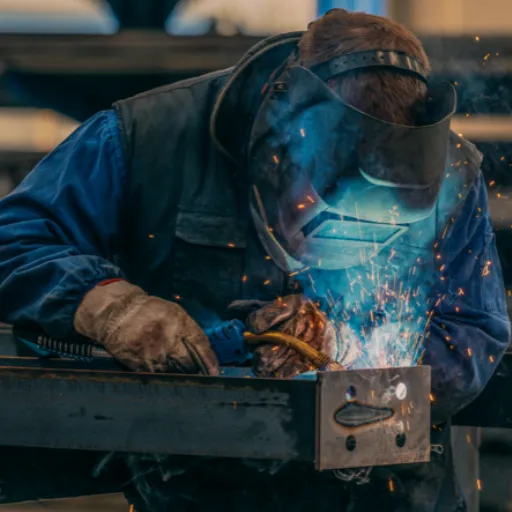
Welding is not limited to the joining of metals, but it is also the expressing of an art that requires care, a skill, and a willingness to learn. If you are the type of person who enjoys working with his hands, is attracted by the shortage of skilled labor, or is impressed by the visible outcome of a finished product, then welding is the right career for you – it is rewarding and versatile. But how demanding is a welding job? This article is going to guide you through everything you need to know; the skills, education, and different opportunities that are available in this thriving sector. If you have been considering welding as your career or merely curious about it, then you are certainly in the right place. Get your protective gear on and get ready to go on a trip to the welding world!
More Than Just a Steady Hand: Essential Welder Traits

Physical Stamina and Dexterity
The occupation of welding is highly demanding and offers a professional life with long, tiring hours, good physical endurance, and technical skills. The routine of welders often includes standing all day long with the practice of doing their works in the most awkward positions like: kneeling, crouching or even overhead. It will be very hard for them to keep the same quality if the physical stamina is not there in the first place. Besides this, dexterity is required for the proper handling of tools, as the whole welding process is based on the execution of movements to the very last point for making the joints strong and clean.
The recent rise in questions regarding “how physically demanding is welding” indicates a growing interest in understanding the job’s physical requirements, as shown by the filtering of data from s search trends. A welder must possess core strength to operate heavy equipment and at the same time be very skillful with hands to create the detailed and accurate work that is going on in industries like construction or aerospace. Endurance training along with manual precision ensures safety and efficiency, thus making the physical traits of welders indispensable in the field.
Mental Focus and Attention to Detail
The welders’ work features mental focus along with the toughest eye for detail as the basic requirements of welding which will affect the quality and reliability of the work done. The search engine’s latest data reveals that people’s curiosity has escalated over how much concentration can be kept by the welders during their long and intricate tasks. Precise joining or complex patterns projects especially need this very high power of focus. Mindfulness practices, scheduled breaks, and the use of advanced tools such as auto-darkening helmets for less strain and better accuracy are some of the ways that the welders are applying for getting the most of their concentration and being detail-focused. The high standard of performance that is required by the automotive, manufacturing, and shipbuilding industries is being kept up by welders through alertness and focus on the details.
Problem-Solving Abilities
The welders are really good at problem-solving and this is the one and only skill that makes them the ones to take the challenges in the coming projects. The issues such as using bad materials, the occurrence of warping, or the machines breaking down need quick and clever answers. For example, a welder might have to switch the method or tool in the middle of the process to suit the different thicknesses of the materials or the hot-temperature limitations. Having a good grasp of metallurgy, heat dynamics, and various welding methods they can give the product that has passed safety and aesthetic standards. Interruptions caused by problems can not only be lessened but also the overall work done be increased significantly as the latest statistics clearly point out that efficient troubleshooting does not only help in speeding up the work but also in cutting down the project time, which, indeed, is a critical factor for industries needing precision and dependability.
Building Your Foundation: Education & Certification

High School Diploma or Equivalent
A high school diploma or its equivalent is the most basic requirement for the youngsters wanting to enter the technical and skilled trades career. Research in search engine shows that manufacturing, construction, and engineering sectors have made it a habit to consider only the candidates with high school diplomas or GEDs. By certifying such educational minimum, the individuals are made to learn the skills of mathematics, reading understanding, and using logic to solve the problems which are the main qualities for such activities as reading technical drawings, taking measures, and having aware of the safety regulations. Thus, the combination of this basic education, specialized training, or certifications can greatly increase job prospects and career development in these fields.
Welding School and Vocational Programs
Welding schools and vocational programs have a crucial function in molding candidates for the welding profession by presenting thorough, hands-on training. A survey of recent data reveals a trend of employers increasingly looking for formal education in welding among their candidates which is being driven by the introduction of new technology and increased safety requirements. The welding school teaches its students the most important skills such as reading blueprints, operating equipment, and advanced welding techniques such as TIG, MIG, and stick welding. Moreover, some institutions also offer certifications which meet the industry requirements, for example, those that are given by the American Welding Society (AWS), this way the credibility and the income potential of the worker go up. In other words, steady demand for qualified welders in manufacturing, construction, and infrastructure repair is being projected by the U. S. Bureau of Labor Statistics, hence, the enrollment in a welding training center or trade school provides a strong career foundation for long-term success.
Apprenticeships and On-the-Job Training
apprenticeships and on-the-job training are the essential components of building the skilled welders who possess both practical experience and theoretical knowledge. ‘s search engine data from recently suggests that the interest in apprenticeship programs for the trades related to welding has risen remarkably, which is the outcome of acknowledging their worth by many people. Most probably, the programs will allow the students to earn money while they are learning, thus gaining hands-on training under the watchful eye of the professionals with expertise. The apprentices become even more knowledgeable about the industry’s operations, safety rules, and techniques and therefore are well positioned for success in the competitive job market due to their participation in real-world projects. In addition, a significant number of these jobs are provided due to the collaborations among employers, labor unions, and trade schools which also facilitates the accessibility and alignment with the industry.
The Importance of Welding Certification
Welding certification is the most important factor of the skill’s proficiency and safety assurance in the welding occupation. A recent study reflects that the phrases “welding certification requirements” and “how to become a welder” have become frequently searched during the recent past which is a evidence of the growing consciousness about its importance. A certification from an approved institute for welding acts as the proof that the welder really can produce work meeting the industry’s both quality and safety standards thus making him/her more acceptable to employers. In addition, the certifications like the one offered by the American Welding Society (AWS) not only help the employees to keep pace with the latest developments in welding technologies and practices but also assure that the usual problem of unemployment in the area of welding is erased, however, this is achieved through the less access to higher-paying jobs. Furthermore, the welders with certificates are considered as the major contributors to the creation of high-quality, structurally sound work in various sectors i.e. the industry, thus, indeed they are the ones who help build and maintain the global trust and the safety standards.
Where Can Welding Take You? Career Paths & Industries

Manufacturing and Construction
Welding is an essential work in both the manufacturing and construction sectors thus making it one of the most sought after skills. Reports have indicated that there is a hike in searches for “welding jobs near me” and “welding opportunities” to a great extent, which is a clear sign of the strong demand in these sectors. One of the first steps for the manufacturers is to have experienced welders who can very precisely assemble the machines and vehicles and the most critical equipment thus ensuring good and long-lasting products. The construction site equally calls for a welder to carry out the various operations of steel-making, strengthening the frameworks, and even laying down pipelines. This need is mainly driven by the global infrastructure projects that are taking place as the world pointing out the importance of welders in the big picture of building, bridges, and other vital structures. If you are a welder with ambition to work in these industries, you can be certain of steady job opportunities and potential for growth.
Automotive and Aerospace
Welding is crucial for the global automotive and aerospace industries as it guarantees that products are long-lasting and provide good performance. Welding activities have a vast scope, the broadest of which is building up car frames, welding exhaust systems, and assembling the parts of the fuselage and engine of an aircraft. Welding takes the central role in the whole process of manufacturing and repairing. To buttress this view, one could mention recent studies that indicate an increasing fascination with such modern welding techniques as laser and friction stir welding whose application in these industries for fabrics of strong yet light materials is growing day by day. Apart from these advantages, the mentioned technologies will not only enhance the fuel economy and reduce carbon emissions, but they will also cater to the demand for green transport solutions. Thus, mastering these top-notch skills will provide the candidacy of welders to get into.
Shipbuilding and Repair
In maritime industry shipbuilding and repair are very essential sectors that demand high level of precision, skill, and flexibility. The modern welding technology has created the big difference and the synchronization of the shipbuilding and ship maintenance through the usage of robotic welding systems and hybrid laser-arc welding. Recently -based search trend has shown that the curiosity about eco-friendly practices in the shipbuilding industry and even beyond the use of lightweight materials, eco-coatings, and energy-efficient designs is continuously increasing. These novelties strive for two goals: to lessen their environmental impact and to meet the most stringent emission standards globally. For those who are either wanting to develop their skills in this area or already working in the field, familiarizing with as part of continual learning is not only encouraged but also regarded as a factor aiding in their career advancement. How to make shipbuilding companies stay competitive while the market is changing? It’s through the usage of the most advanced technologies and definitely making green manufacturing processes a high priority; thus, the shipbuilders will not only be satisfied with the demands of an eco-friendly world but also the requirements of today’s market in terms of being cost-effective and efficient.
Self-Employment and Entrepreneurship
Self-employment and entrepreneurship are the two spheres that promise unlimited possibilities for the ones who are ready to take risks and be creative. The latest statistics from the search engine show a huge increase in the number of searches for “how to start a business” and “freelance opportunities”, which are indicative of the rise in the number of people opting for self-employment and independent careers. In order to get a competitive edge in the industry, one has to use the new trends such as e-commerce, digital marketing, and going green in business models. Using creativity along with analysis and data-based decision-making could be the way for the entrepreneurs to meet the customer’s needs while at the same time developing businesses that are scalable. It appears that the future of work is swinging towards flexibility and creativity, and self-employment is one of the strongest means to make the most out of these trends.
Forging Your Future: Tips for Success

Get Practical Knowledge
If you aspire to be a prosperous entrepreneur, then it is quite essential to master the practical knowledge. One good way to do it is by setting up real-life projects which align with your business ambitions through internships, freelance jobs, or small startups. The most recent search trends have shown a very noticeable increase in the popularity of phrases like “how to start a side hustle” and “hands-on skills for entrepreneurs,” which is a clear sign that experiential learning is still in demand. Not only do you receive skills but also through active participation in the real world you will be meeting people, getting tough and so on. Remember that every meeting, whether good or bad, is a step towards gaining mastery and ultimately, victory.
Build Relationships with Experts
Having a network of professionals greatly increases your chances of getting opportunities that can help you develop both personally and professionally. To support this claim, the recent search data shows upsurge in the interest of people looking for entrepreneurial skills as well as side hustles, meaning networking is an increasingly important skill to have. The question “How can networking contribute to success?” has an answer based on the exchange of knowledge, asking for advice, and collaboration. By being in touch with the industry experts as well as fellow workers, you not only get the tips that can improve your skills, discover possible alliances, and keep abreast of trends. Good networking is not only about exchanging ideas but also about raising one’s profile in the industry, thus opening up the way to long-term success.
Frequently Asked Questions
What are the steps involved in becoming a welder?
In the typical case, the path to becoming a welder consists of multiple stages. To start, it is important to sign up for a welding program in a community college or a technical school. The latter offers the training necessary to know various welding methods like arc welding and gas metal arc welding. Upon acquiring the degree, it is imperative to get hands-on experience through internships or working as a beginner welder. Eventually, getting a welder certification from an authorized test center like AWS will not only improve your career but also give you a place in the welder’s domain.
How long will it take to gain the status of a certified welder?
The duration of the process to become a certified welder is directly related to the selected training program. For example, the welding technology program at a community college may take anywhere between 6 months and 2 years. Some people may go for the faster welding courses concentrating on certain skills, and they can be done in only a few weeks. After finishing your program, getting a certification might take additionally time according to the particular demands of the certification procedure. Thus, eventually, plan for the period of several months to 1-2 years of your full certification.
What is the range of the welder’s salary?
Welders’ salaries are largely dependent on experience, location, and the type of welding they are engaged in. The beginners in welding will probably get the lowest pay, although, with time and possibly another qualification such as acceptance to the certified welding inspector, they could reach the high earning level. The average annual salary for a welder, as per the industry’s studies, can be from 35,000 dollars to over 60,000 dollars, with specialized welders in hot-sectors earning much more. Moreover, higher pay is the common practice for those who choose to improve their skill levels or take up management roles in the welding industry.
What are the necessary abilities to become itprong in a welding career?
In the welding sector it would be hard to find a professional who does not possess the three characteristics of integrity, honesty, and reliability as their basic strengths. From the beginning, it was required to know the different methods, for instance, Cleveland arc welding, and to be really precise when interpreting welding symbols and correcting one’s work. Good hand-eye coordination and manual skill are very helpful for people who do diverse welding tasks. Moreover, a strong work ethic along with the ability to follow safety measures could very well increase a person’s productivity and standing in the area. Finally, continuous learning and being up to date with the latest welding technologies and methods will be very much required for career advancement.
What is the main occupation of the welder?
The basic work of a welder usually includes a lot of different tasks related to welding and fabrication. They cooperate with the fabricator designer and the technical drafter to get the project’s requirements and specifications. In addition to that, welders use different methods like MIG and TIG for joining the metal parts. Besides, welders take on the crucial task of assessing the quality of their work and ensuring safety during the processes. Working along with other welding experts might be a part of the welder’s job when dealing with intricate projects besides engineers. All in all, a welder’s work requires not only the technical skill but also a high level of dedication to the quality of the final product.
Reference Sources
Ohio Department of Transportation: This page discusses the AWS Certified Welder program, which is performance-based and highlights the skills required for welding. Visit the source.
U.S. Bureau of Labor Statistics (BLS): This resource provides detailed information about the education, training, and skills needed for welders, cutters, solderers, and brazers. Visit the source.
American Welding Society (AWS): This PDF document outlines the Certified Welder program, emphasizing the performance-based nature of certification and the lack of prerequisites. Visit the source.