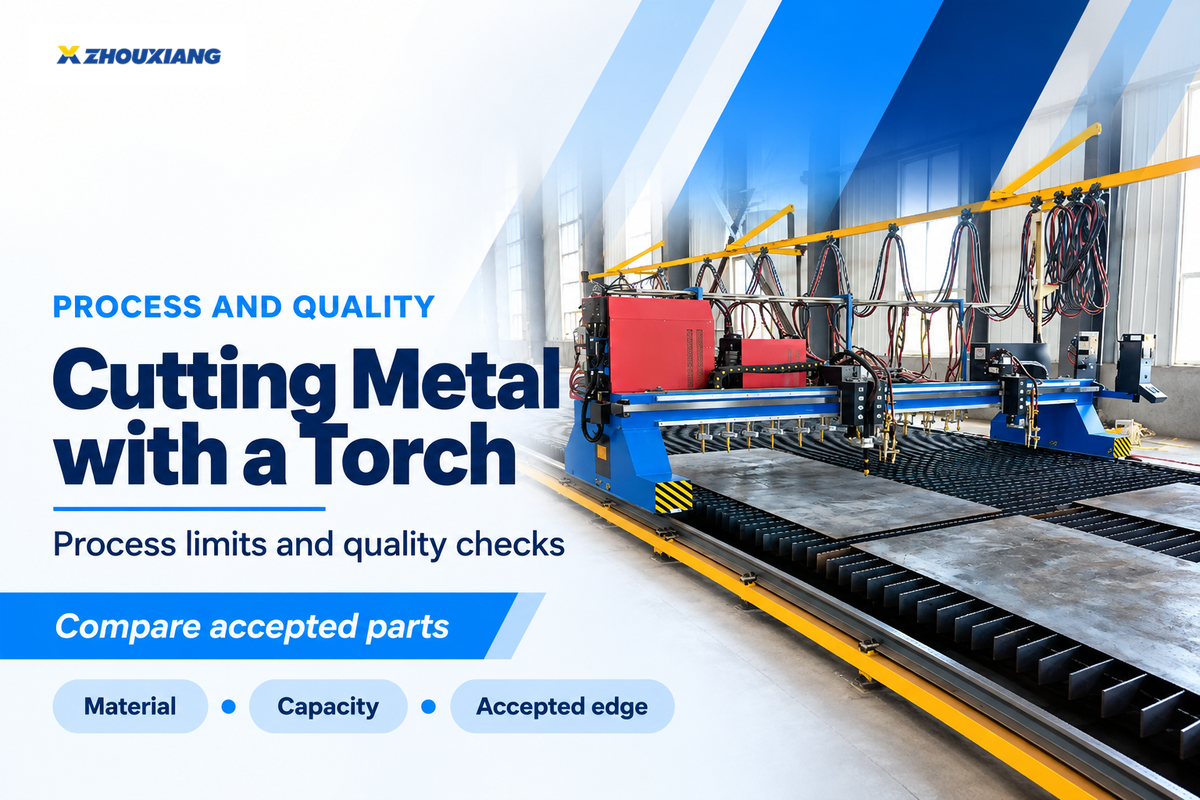
Cutting metal with a torch commonly means oxy-fuel cutting. A flame combines oxygen and fuel to heat the metal and a stream of oxygen reacts with metal to complete the cut. Carbon steel is the most common application. Make sure to evaluate material compatibility, combined equipment rating, the condition of the cut edge, and the demand for the next operation on the part.
A cut can occur within the plate, but the part may still fail the drawing requirements. A rounded edge may remove machining stock; an irregular blank may not seat in a welding fixture. This guide explains the use of torch cutting, how to evaluate results, and relative costs of plasma and laser cutting.
Quick process check
- Process: preheat, oxygen-driven oxidation and slag removal.
- Material starting point: suitable carbon and low-alloy steel, with grade-specific requirements.
- Capacity: use the matched torch, tip, fuel and supply specification.
- Release: inspect the cut, then apply drawing and end-use acceptance requirements.
What torch cutting does to steel
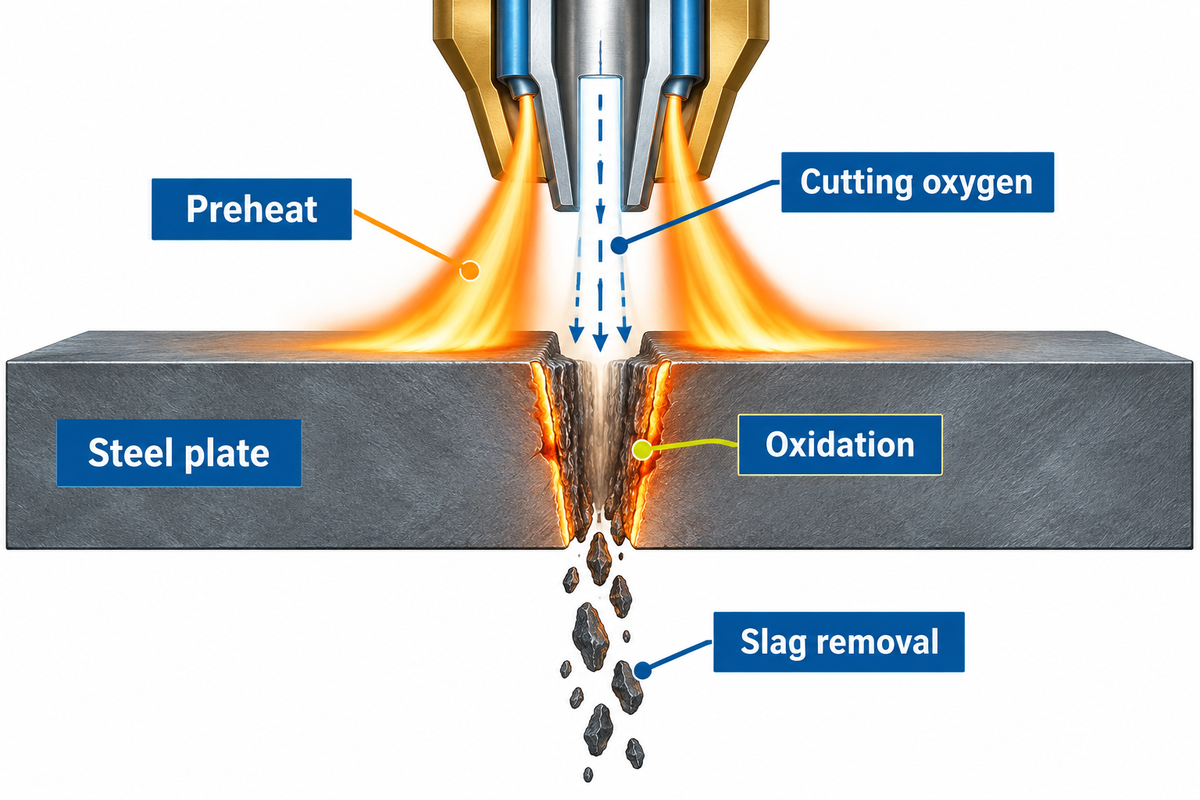
Oxy-fuel cutting moves through the plate by means of a controlled reaction. The torch flame heats the starting area and cutting oxygen reacts with the hot steel. The oxide is removed from the kerf, which allows the reaction to move along the path.
In TWI’s explanation of the oxyfuel process, steel reaches its ignition temperature below its melting point. The oxygen jet supports the reaction and slag is removed. Describing everything below the torch as molten metal misses the key difference of the process. It isn’t simply heating a section of metal to collapse. The burning metal produces metal oxide that flows from the kerf.
Can a torch cut through steel?
Yes. An appropriately rated oxy-fuel gas cutting torch can cut through steel when the right material, thickness and gas supply are considered. The flame preheats the starting area to ignition temperature, and the cutting oxygen sustains the reaction through the plate. Without a sustained cutting oxygen reaction, a gas torch can produce a hot spot or melted metal. A heating torch doesn’t have a separate cutting function like a gas cutting torch.
It makes a difference when choosing tool attachments. A welding torch or welding tip forms a molten pool of metal for joining, and a cutting attachment supplies the separate cutting stream. Before you use a cutting torch, confirm the intended duty of the torch body and torch handle and choose consumables for cutting and welding accordingly. With equipment of the oxygen and acetylene type, a cutting lever controls the supplemental oxygen flow. Read the equipment rating and its thickness limit.
Which metals can an oxy-fuel torch cut?
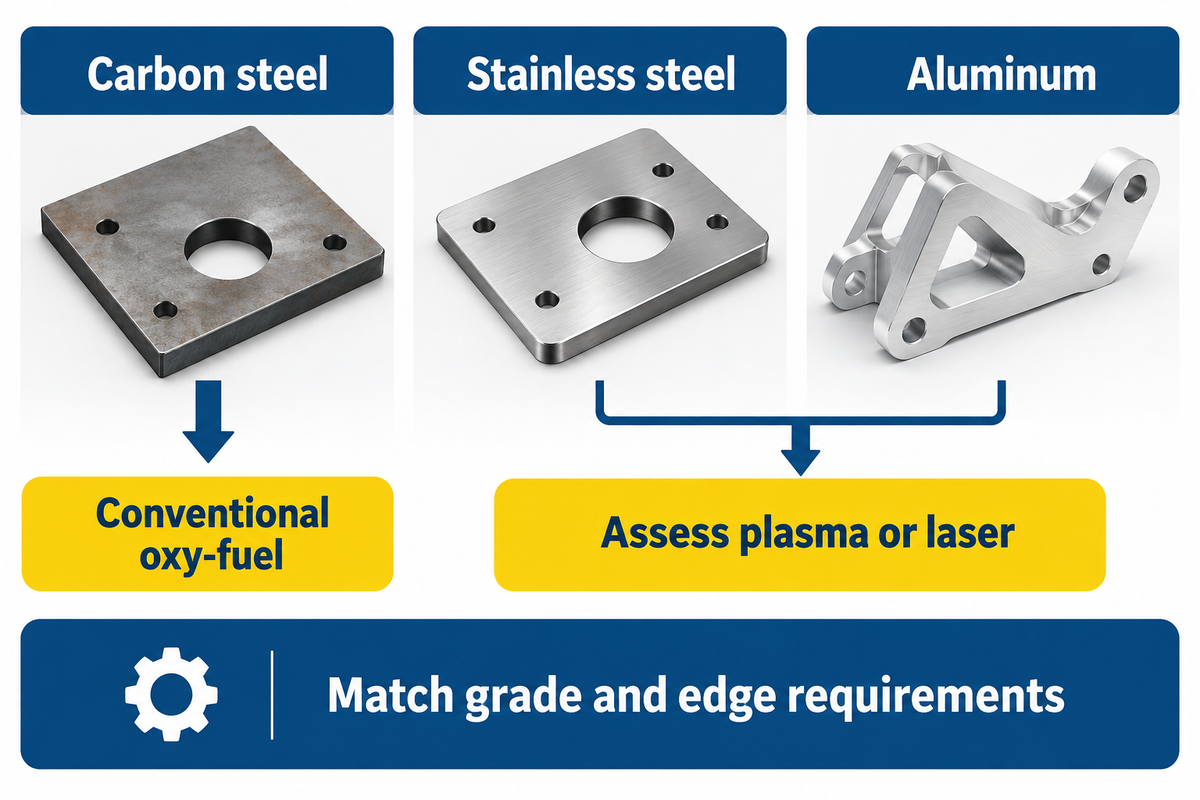
Conventional oxy-fuel cutting can be applied to steels whose ignition and oxide behavior support the reaction. Removal of the oxides makes it possible for the reaction to proceed. Carbon steel is usually the starting material. Stainless steel, aluminum and cast iron introduce obstacles, and changing flame temperature alone won’t help to transform an ordinary torch into a suitable process for the production of these metals.
The oxide must be removable while the reaction continues. Refractory oxides inhibit that. TWI describes powder-assisted oxygen cutting as a specialist method that changes the process by adding material to the reaction. It must not be confused with an ordinary oxyacetylene torch fitted with a larger nozzle.
Can I cut stainless steel with a cutting torch?
The refractory oxides present in stainless steel prevent conventional oxy-fuel cutting from working as it does on carbon steel. Powder-assisted techniques are available; however, these would require a different process and equipment. For production stainless parts, assess a suitable plasma or laser system against the actual grade, thickness and edge requirements, instead of treating a standard torch as interchangeable.
Consider the case of a fabricator quoting carbon-steel brackets and stainless covers in the same job. Using one torch set for both materials might be convenient, but a shared drawing format says nothing about the cutting compatibility of the two materials. In such a case, separate the materials, and then compare cycle times. Oxy-fuel cutting of the brackets allows a judgment of cutting quality against its machining allowance. Cutting the covers allows a judgment of a process meant for stainless. In both cases, the material should be of the right size for the assembly.
How thick of steel will a torch cut?
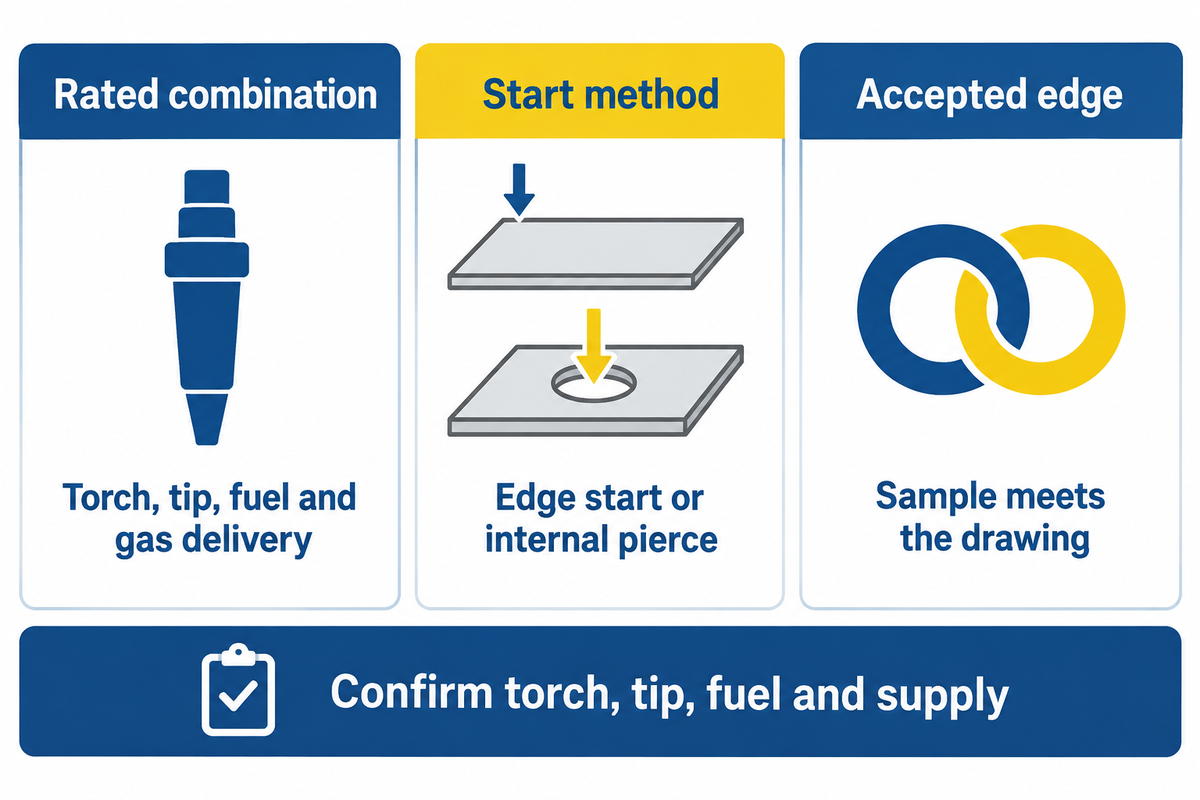
TWI describes a broad oxyfuel process range of 0.5 mm to 250 mm. This broad range can cover different types of equipment and applications. It’s not the range of a handheld torch. The usable thickness for a job comes from the specified torch, cutting tip, fuel, gas delivery and starting method, followed by a sample that meets the drawing.
A supplier’s max severance figure answers only part of the question. State whether the job starts at an edge or requires an internal pierce, and obtain the associated rating. A plate with an enclosed opening may require a different starting arrangement from an outside profile, even if both the elements use the same thickness of stock.
Identify the torch head and tip size by part number, state the selected fuel gas, and have the supplier confirm the required flow at the equipment. Use three entries on the purchase specification: rated combination, start method and accepted edge. A regulator pressure in psi, without its flow condition specified, is an incomplete comparison.
Thickness makes a difference in the consequences of unsuitable travel rates. A 2023 robotic oxy-propane cutting study tested steel plates 0.250, 0.375, and 0.500 inches thick. With some cuts, excessively slow travel caused resealing, while high travel speeds also produced failures. Those experiments demonstrate that “moving slower until it works” is a poor universal rule. They don’t provide settings for an operating torch.
For thin sheet metal, distortion and feature retention should be incorporated in the trial, and successful separation shouldn’t be the purchase decision criterion.
Torch equipment and safe job preparation
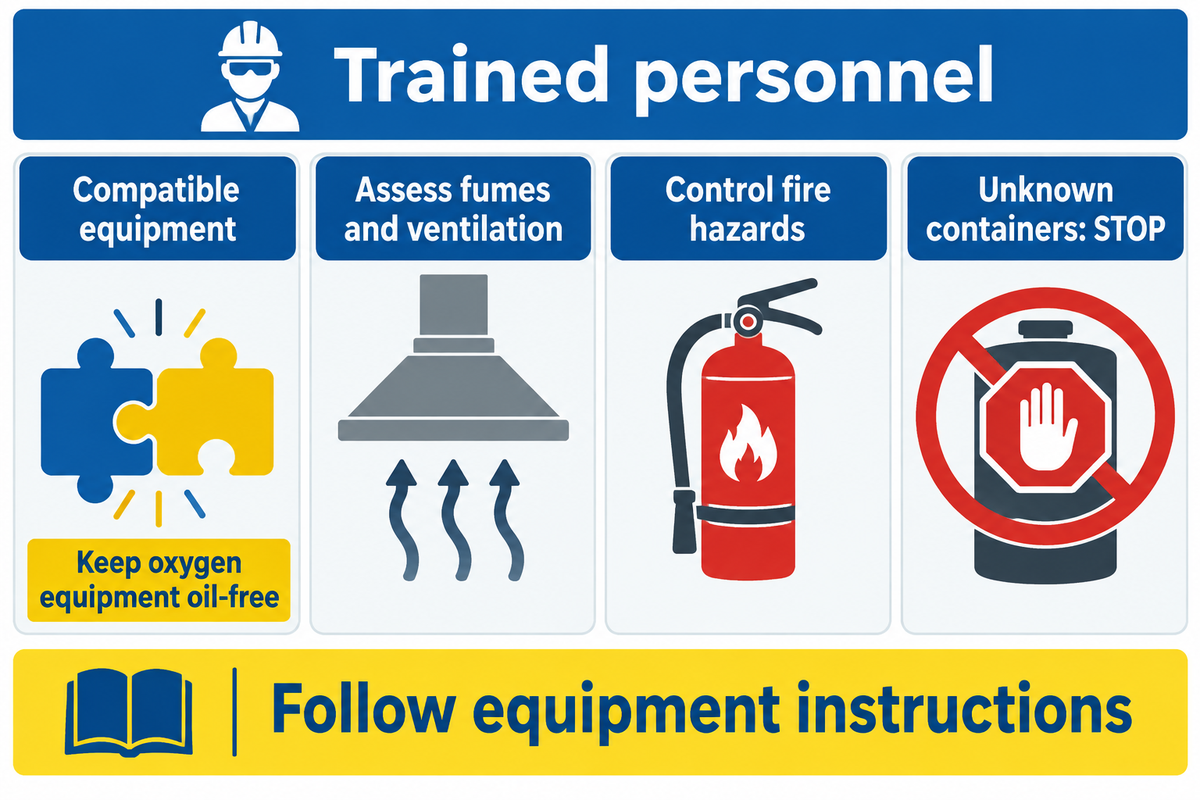
Safe torch work consists of using a compatible equipment system with an authorized job, performed by trained personnel. Match the torch, hoses and regulators to fuel and oxygen service, and assess the material, coatings, adjacent combustibles and work environment before anyone is authorized to weld or cut. Equipment instructions and the site’s hot work procedure govern operation.
OSHA 1910.253 covers oxygen-fuel equipment and operator competence. Oxygen equipment must remain free of oil and grease. An oxygen regulator and an acetylene regulator have different service duties; don’t assume a fitting that can be connected is suitable. Acetylene hoses, the torch valve and the valve on the torch body belong in the equipment inspection, along with the specified protective devices.
Prior to using an acetylene tank or changing fuel, follow the supplier’s instructions on handling and compatibility for acetylene gas. A gas valve on the torch is one element of a system. The oxygen valve on the torch and the cutting valve have equipment-specific functions which the operator must understand prior to lighting or shutdown.
OSHA 1910.252 covers fire precautions, eye protection, and ventilation. Suitable goggles or other specified eye and face protection need to be provided for the task. Even with a blue flame, the task requires controls on fumes, fire precautions, and equipment checks. Check the system, then evaluate the cutting flame.
Unknown containers are a stop point. Used drums, tanks, and connected piping can retain substances which on heating can give off flammable or toxic vapors. OSHA provisions for used containers require hazardous residues to be eliminated and address connections and venting. Arrange for a competent assessment and required controls; an apparently empty vessel isn’t a ready-to-cut piece of metal.
Coatings require separate attention. Identify zinc, paints, and other surface coatings and materials, and determine appropriate engineering controls, including ventilation. Neither a general torch guide nor an instruction to “work outside” solves every coating or confined space problem.
Cutting quality: inspect the edge before releasing the part
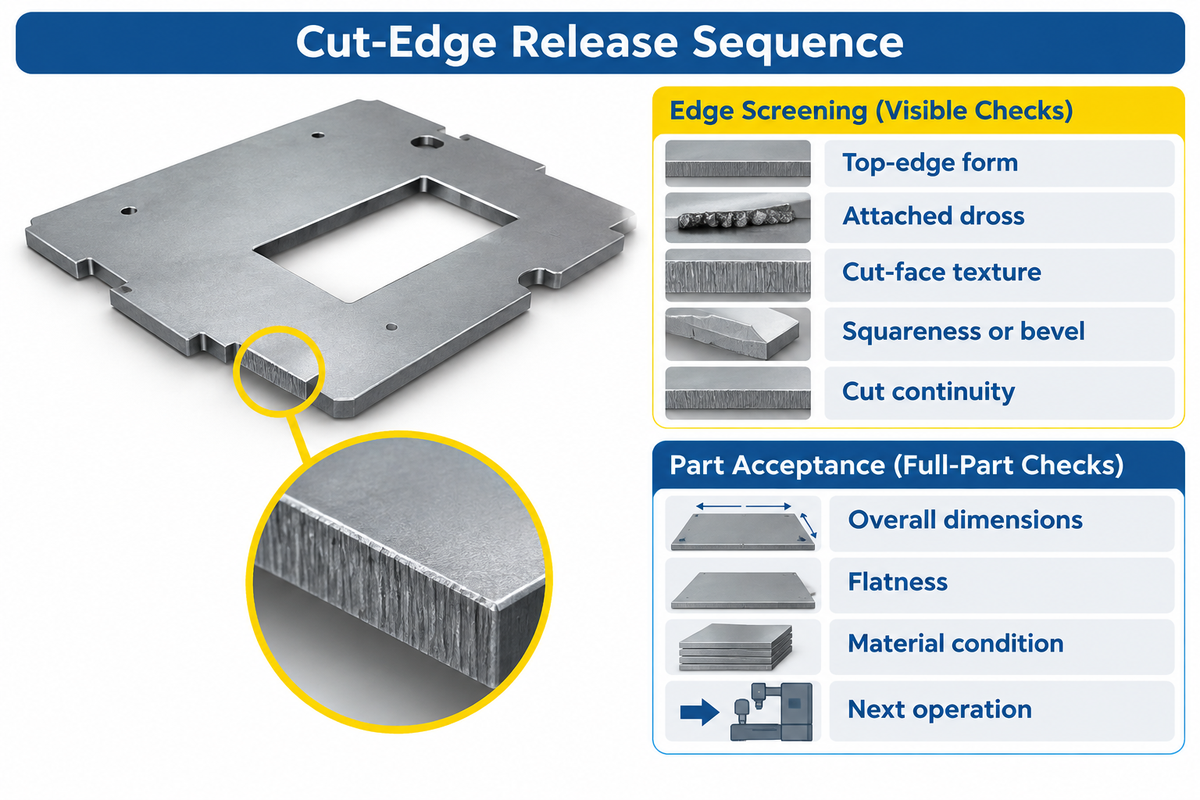
Five cut-edge checks provide a first screening: top-edge form, attached dross, cut-face texture, squareness and continuity. Compliance with the drawing also means meeting the dimensional, flatness and material requirements before release to the next operation. Inspect the condition that the next operation will receive, with all required cleaning done and recorded.
The public scope of ISO 9013 links its application to drawings or delivery documents. A standard number on a quotation should lead to an agreed quality requirement and measurement method.
“Flatness defects are not addressed as such in this document.”
Cut-Edge Release Sequence
Use the first five rows to screen the cut. The remaining rows connect that inspection to part acceptance, and prevent an attractive edge from becoming an automatic release.
| Check | Record | Decision before handoff |
|---|---|---|
| 1. Top-edge form | Rounding, melting or local loss of the intended corner | Confirm remaining profile and machining stock |
| 2. Attached dross | Location and removal work needed | Assess the edge after the specified cleanup |
| 3. Cut-face texture | Drag marks, gouges and rough areas | Measure against the ordered surface requirement |
| 4. Squareness or bevel | Deviation through the section at agreed locations | Compare with the drawing’s edge geometry |
| 5. Cut continuity | Unsevered bridges or local interruptions | Resolve incomplete areas before accepting the profile |
| Overall dimensions | Required datums, holes and profile measurements | Release only within the specified limits |
| Flatness | Distortion using the agreed support and measurement method | Apply the separate drawing requirement |
| Material condition | Applicable heat-affected-zone or hardness requirements | Hold for required verification or approved treatment |
| Next operation | Weld preparation, machining or coating acceptance | Record acceptance, rework or rejection |
Heating effects extend below the visible cut face. The study by Martín-Meizoso and others in 2014 on oxy-fuel heat affected zones examined the microstructure, hardness and mechanical properties of 25 mm S460M steel. It isn’t possible to carry out a visual check to determine those properties. If the material specification or end use of the part requires additional verification, complete it before release.
Consider a part that passes its outside dimensions after grinding, but doesn’t fit on the welding fixture. Rechecking the part’s cut face won’t resolve the fit problem. The inspector will need the specified flatness requirement, agreed supports, and measurement outcome.
If these are omitted from the purchase drawing, the buyer and seller must settle on an acceptance basis before the next batch is processed. Record the time spent grinding off the dross, since grinding can remove the dross and restore the required surface while adding labor costs to an apparently inexpensive quote.
From torch travel to repeatable production
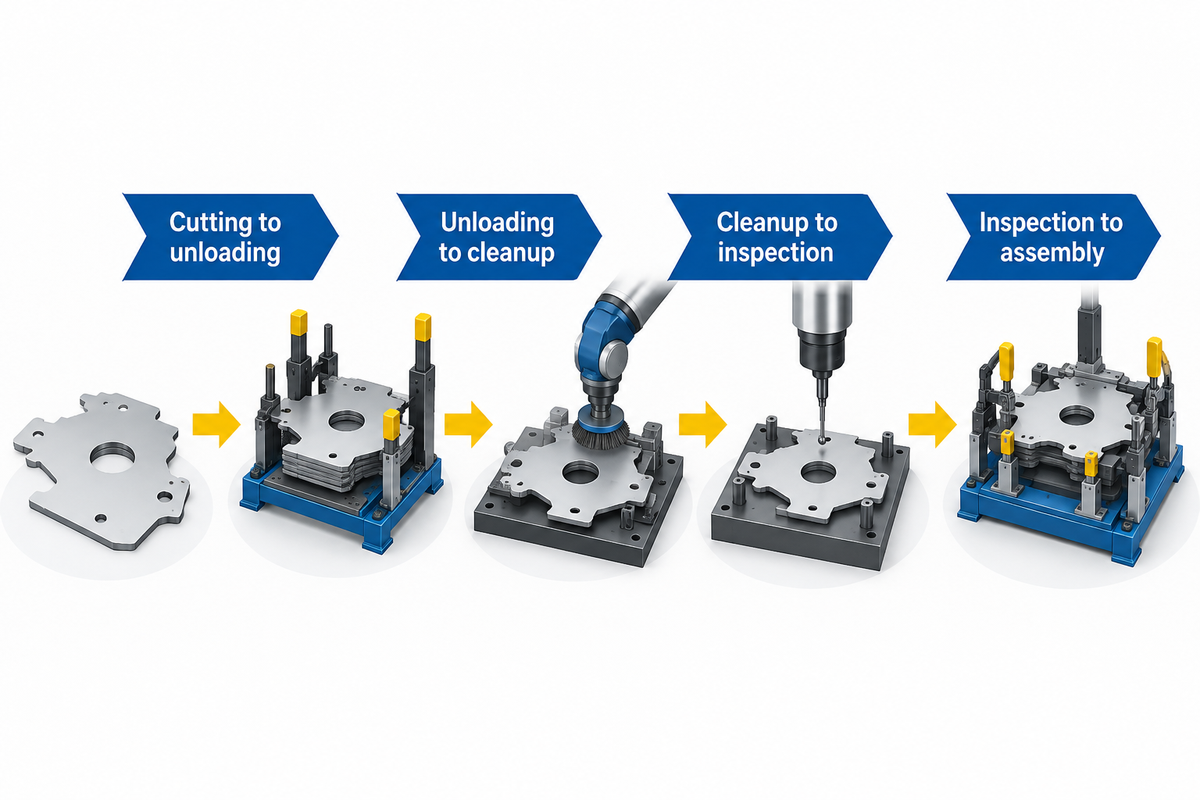
Repeatable results for torch cutting depend on control of the equipment condition, gas delivery and travel, followed by an inspection of the resulting edge. A symptom at the cutting edge isn’t a unique diagnosis. Record the approved setup and result to allow the next person to move the torch and detect a change in material or equipment.
The Fabricator’s 2024 overview of oxyfuel cutting quotes ESAB on nozzle selection and states that excessive nozzle size can increase waste. Turning up gas flow is not a reliable fix: uncontrolled increases in pressure can make the results worse. Record the used torch tip and verify its condition using the equipment instructions.
Why won’t my cutting torch cut?
When a cutting torch fails, start with the likely causes: unsuitable material, an incorrect combination of equipment, inadequate gas delivery, or a process that never establishes a stable cut. Stop and inspect the setup as per the manufacturer’s instruction. Uncontrolled increases in pressure or repeated reduction in speed can make the results worse.
Look beyond whether the tip of the flame makes contact with the plate. There are different causes and remedies for a blocked or damaged nozzle, an incorrect or poorly controlled fuel setup, and unmanaged travel. A welder’s experience in setting up a weld doesn’t, in and of itself, qualify that person to set up a cutting system. If molten steel seems to bridge the kerf behind the torch, preserve the sample and setup record for diagnosis. Don’t treat all the material as ordinary loose slag.
The Fabricator’s discussion of oxyfuel automation draws partly on IHT Automation and points out the process control functions (i.e. height control and gas sequencing) and the remaining degree of automation. A production handoff still must be made.
- Cutting to unloading: can the part be removed without disrupting the next job?
- Unloading to cleanup: does grinding capacity keep pace with the accepted output?
- Cleanup to inspection: are gauges and drawing requirements available?
- Inspection to assembly: does the edge meet the next process’s preparation requirements?
Oxy-fuel, plasma or laser: compare the finished part

Choose between oxy-fuel, plasma and laser by comparing accepted sample parts from the intended production route. Material compatibility comes first, followed by thickness, feature geometry and edge requirements.
The Fabricator’s supplier-authored comparison of plasma versus oxyfuel explores the cost of ownership of the different equipment. Historical prices aren’t good benchmarks for quoting. Each row of the following matrix describes what a sample part would need to resolve to determine the likely better process.
| Job type | Process route to assess | Evidence needed from the sample |
|---|---|---|
| Carbon-steel outside profile | Oxy-fuel, plasma or laser within the equipment rating | Profile, edge condition and total handling time |
| Thick carbon-steel blank | Matched oxy-fuel system; compare rated alternatives | Start method and acceptable edge through the section |
| Enclosed opening | System with a verified piercing route | Entry damage and finished opening dimensions |
| Stainless cover | Suitable plasma or laser system | Grade compatibility and required finish |
| Aluminum part | Suitable plasma or laser system | Material-specific setup and finished geometry |
| Thin sheet with fine features | Compare a suitable laser route | Feature retention, distortion and handling |
| Blank to be machined | Route retaining specified machining stock | Allowance and relevant edge material condition |
| Weld preparation | Route matching the welding preparation | Bevel geometry, cleanliness and fit-up |
| Repeated nested batch | Compare actual machine and labor arrangements | Accepted output per shift and downstream queue |
Zhouxiang’s metal laser cutting machine page provides a starting point for laser comparisons for repeat sheet and plate work. Send the same material grade, drawing and acceptance requirements used for the torch sample. Include the complete route to an accepted part for the comparison, including the required edge preparation.
What torch cutting costs per acceptable part
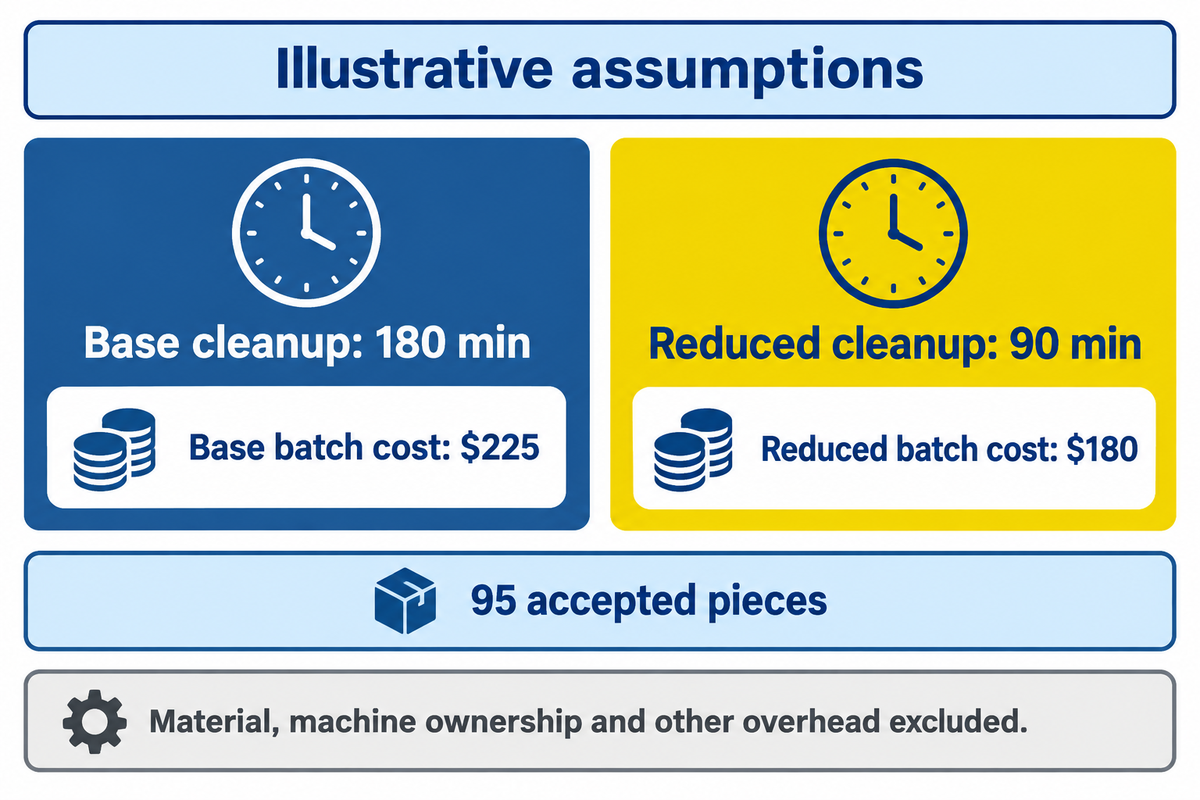
The cutting conversion cost per accepted part is the included batch processing cost divided by the number of accepted parts. For torch work, count setup, cutting, handling, cleanup and inspection, without counting labor and machine time twice. State which material, capital and other costs are excluded from the analysis so that a low gas bill doesn’t skew the comparison in favor of torch cutting.
A 2020 University of Strathclyde ship-recycling study modeled ship-dismantling scenarios using processing time and labor costs. In the modeled scenarios, a process with a higher running cost could still produce a lower job cost. The study used manufacturer data, and its surface-cleaning step occurred prior to cutting. That pre-cut cleaning step differs from post-cut grinding in a typical fab shop.
Accepted-Part Cost Bridge
Illustrative assumptions: a batch starts with 100 pieces and yields 95 accepted pieces. One operator performs all stages sequentially at an assumed loaded labor rate of $30/hour. Cutting takes 120 minutes; setup takes 30 minutes; handling and inspection take 30 minutes. Cleanup takes 180 minutes. Gas and consumables cost an assumed $45 per batch. Material, machine ownership and other overhead are excluded.
| Batch item | Base example | Reduced-cleanup example |
|---|---|---|
| Pieces started | 100 pieces | 100 pieces |
| Pieces accepted | 95 pieces | 95 pieces |
| Setup labor | 30 min; $15 | 30 min; $15 |
| Cutting labor | 120 min; $60 | 120 min; $60 |
| Cleanup labor | 180 min; $90 | 90 min; $45 |
| Handling and inspection | 30 min; $15 | 30 min; $15 |
| Total sequential labor time | 360 min; 6 hours | 270 min; 4.5 hours |
| Gas and consumables | $45 per batch | $45 per batch |
| Included batch cost | $225 | $180 |
| Included cost per accepted piece | $225 ÷ 95 = $2.37 | $180 ÷ 95 = $1.89 |
The base arithmetic is 6 hours × $30/hour + $45 = $225. Reducing cleanup alone to 90 minutes saves $45 per batch under these assumptions. That’s about $0.47 per accepted piece, calculated before rounding the displayed unit costs. Assuming piece acceptance doesn’t change, the reduced-cleanup column illustrates a cost sensitivity, not predicted benefits of various machines.
For the production manager, cleanup is the largest labor step in this example. Finance should compare the cost to reduce that work with the actual savings, while quality assures that the accepted yield doesn’t change. Keep track of additional cutting time, consumables, and/or capital cost to obtain the cleaner edge. If cleanup runs at a separate work center, measure its capacity and availability, rather than adding parallel elapsed times as if a single operator did the whole job.
Specify the sample cut and production handoff

Make sure your sample-cut request defines material, drawing and acceptance route. Then the supplier determines settings. Define thickness, start geometry, batch mix and following operation. Indicate the edge condition required and the total preparation work required. Procurement can compare offers only if the suppliers are delivering the same accepted condition.
State the ordered standard and edition explicitly. ISO lists ISO 9013:2017/Amd 1:2024 as a September 2024 amendment. Agree the applicable requirements with the supplier rather than using “ISO quality” as an undefined tolerance. Add any materials-property requirements and flatness if required.
Ask for measured results from representative parts, using the proposed gas supply and handling arrangements. Sending a representative drawing is helpful to define the critical features for assembly, and may inform the production method. A clean single sample does not answer whether unloading, grinding or inspection can support the planned batch.
Zhouxiang’s welding and cutting equipment business supplies industrial production equipment. To compare a laser route for your parts, submit a sample-cut request for grade, thickness, drawing and batch quantity and required edge condition.
Frequently asked questions
Can you cut metal with a propane torch?
A specially designed oxygen-propane cutting system can cut suitable steel. A handheld air-propane blow torch for heating is different. It lacks a separate cutting oxygen arrangement. Check that the torch, tip and supply are approved for propane, and assess the material and thickness against the system instructions. Without a cutting-oxygen stream, more heat can leave a hot spot or melted metal instead of a cut.
What should oxygen acetylene be set at for cutting?
Use the pressure and flow requirements of the exact oxy-acetylene cutting torch, tip, fuel and plate thickness. Take the oxygen acetylene setting from the tip chart for that torch and tip; separately, OSHA bars using acetylene at a pressure in excess of 15 psig (103 kPa gauge pressure). The chart must also be in alignment with the stated operating condition. Don’t assume a gauge reading from a forum is a valid setting. Don’t treat a regulatory pressure limit as a recommended cutting setting.
How to light a cutting torch?
A trained operator should light the torch using the equipment manufacturer’s procedure after the required checks and hot-work authorization. Sequences of operations vary with equipment and fuel. An instruction such as “open the oxygen valve” is incomplete; if the correct instructions aren’t available, and/or the system condition is uncertain, don’t ignite.
Can an oxy acetylene torch cut cast iron?
Ordinary oxy acetylene cutting is usually not suitable for cast iron because its composition can disrupt the normal process. There are other methods to do this, but they require other equipment and systems. Choose an appropriate method to get the desired finish for the casting.
Is torch cutting suitable for thin metal?
Thin steel can be cut with some oxy-fuel equipment, but distortion, kerf width, and lost features may produce an unacceptable result. Assess the part in its entirety and not just thickness. A thin blank that separates can still need straightening or fail fit-up. When a part needs fine features or very little finishing, look to a plasma or laser sample.
Can a brazing torch kit cut steel?
A brazing torch kit intended only to heat metal won’t have the cutting function of an oxy-fuel system. Assess the approved attachments and the duty of the kit. A welding or heating flame may not have the ability to achieve an acceptable through-cut.
Can you torch-cut galvanized steel?
Galvanized steel requires assessment of the zinc coating, fumes produced by hot work, as well as the cutting process itself. OSHA 1910.252 includes specific ventilation provisions for zinc-bearing materials indoors and in confined spaces. Have competent persons establish the required controls for hot work; moving the work to another location may not address the exposure conditions.
Related cutting guides
References & Sources
- Oxyfuel cutting: process and fuel gases TWI.
- What is powder cutting? TWI.
- Oxygen-fuel gas welding and cutting OSHA, 29 CFR 1910.253.
- General requirements for welding, cutting and brazing OSHA, 29 CFR 1910.252.
- ISO 9013:2017 public scope ISO/TC 44.
- ISO 9013:2017/Amd 1:2024 ISO catalogue, September 2024.
- Resilience and ductility of Oxy-fuel HAZ cut Martín-Meizoso et al., 2014; abstract reviewed.
- Vision-based Oxy-fuel Torch Control for Robotic Metal Cutting original research, 2023.
- Investigation of Different Cutting Technologies in a Ship Recycling Yard with Simulation Approach Gunbeyaz, Kurt and Turan, 2020 author manuscript.
- An overview of oxyfuel cutting The Fabricator, 2024.
- Process automation meets oxyfuel cutting The Fabricator.
- Plasma or oxyfuel? The Fabricator; historical comparison, not current pricing.