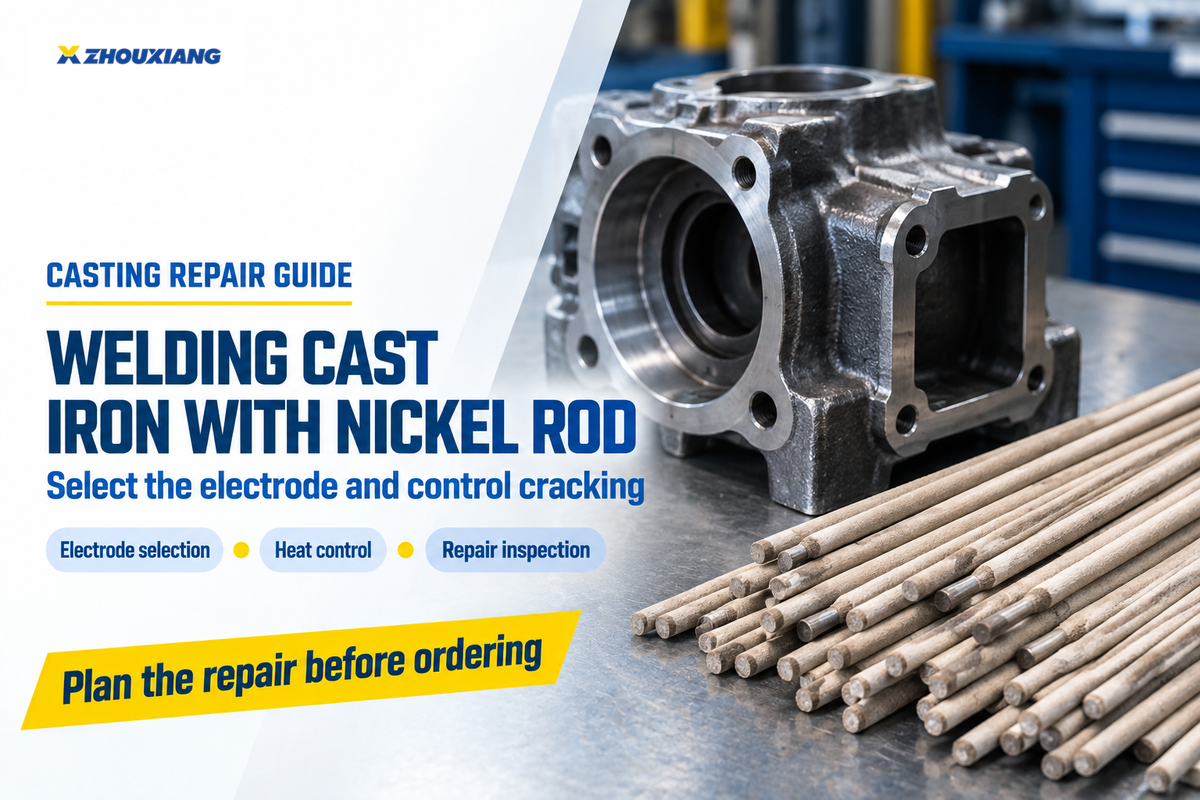
For welding cast iron with nickel rod, consider ENi-CI (Ni99) for single-pass repairs that need machining and ENiFe-CI (Ni55) for suitable thicker, multipass work. Identify the casting, its service, and the crack before selecting the weld. A machinable deposit of nickel can be placed next to a hard crack prone area of cast iron.
Imagine a gear box housing containing a crack next to a bearing bore. This gives maintenance two jobs. The first is to restore sound material. The second is to maintain the bore’s size, alignment and location. Agree on both acceptance checks before starting the work, as a bore can move even when the weld looks sound.
Where to pause. Put the repair on engineering hold for an unidentified casting, a crack through a load path, or pressure, lifting, steering, braking or other safety-critical service. Before proceeding, follow the original equipment manufacturer’s requirements and the applicable repair procedure.
Which nickel rod should you use for cast iron?
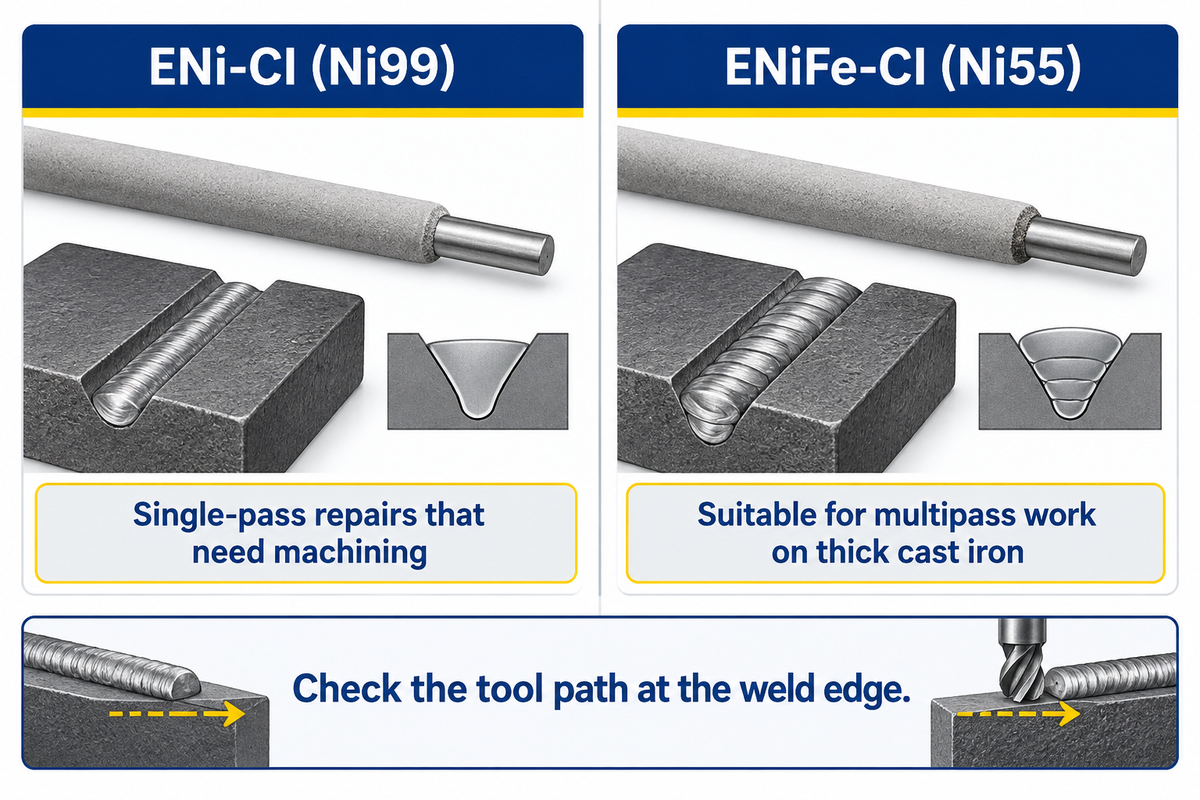
Use ENi-CI for a shallow, single-pass repair that needs machining and consider ENiFe-CI for suitable multipass repairs on thick cast iron. Select an exact covered electrode from an approved procedure and check where the machining tool crosses from weld metal into the original casting.
| Electrode selection criterion | ENi-CI example | ENiFe-CI example |
|---|---|---|
| Product | Lincoln Electric Tech-Rod 99, nominally 99% nickel | Lincoln Electric Tech-Rod 55, nominally 55% nickel |
| Application cue | Single-pass repairs where the deposit needs drilling, tapping or machining | Heavy sections or suitable multipass repairs |
| Machining check | Lincoln describes a machinable deposit even at high admixture for its product. Check the cast iron at the weld edge separately. | Lincoln’s catalog calls for carbide-tipped tools. Lincoln flags high admixture as a condition that can make machining difficult. |
| Request before ordering | Confirm the pass count and the depth and path of the finish cut. | Confirm the product, joint materials, and whether the weld deposit needs machining. |
| Covered electrode form | Match the product and diameter to the stick welding procedure. | Confirm the same details for the exact nickel-iron electrode. |
| Thin machined section | Washington Alloy’s Nickel 99 lists such sections when machining matters. | Check whether the deposit stays machinable at the expected dilution. |
| Dissimilar joint | Selection depends on both grades and the approved joint. | Washington Alloy’s Nickel 55 lists mild steel among its applications. |
| Material at the weld edge | Check where the selected tool will cross the casting-side transition. | The same check applies, especially ahead of a finish cut in a bore. |
The table compares two covered electrodes for cast iron. Although Ni99 is often referred to as pure nickel, the percentages are nominal electrode descriptions in Lincoln Electric’s cast-iron electrode selection guide, separate from the catalog’s typical weld deposit composition. Admixture, also referred to as dilution, is the portion of the weld pool that consists of melted base metal. The first layer is critical to the machinability of the repair. If the cutter runs through the weld edge, the shop’s first-pass evaluation should address admixture and machinability. The same nominal class can have product-specific operating ranges. Some steel electrodes marketed for cast iron produce hard deposits that are finished by grinding, so ask how the choice affects the specified finish.
What does the electrode classification tell you?
It identifies the consumable class. AWS A5.15 sets requirements for cast-iron welding electrodes and rods. Verify the manufacturer’s datasheet for the covered electrode and confirm the casting and joint fall within the scope of the approved procedure. For other base metals, use the guide to selecting welding rods.
Can the casting be welded?
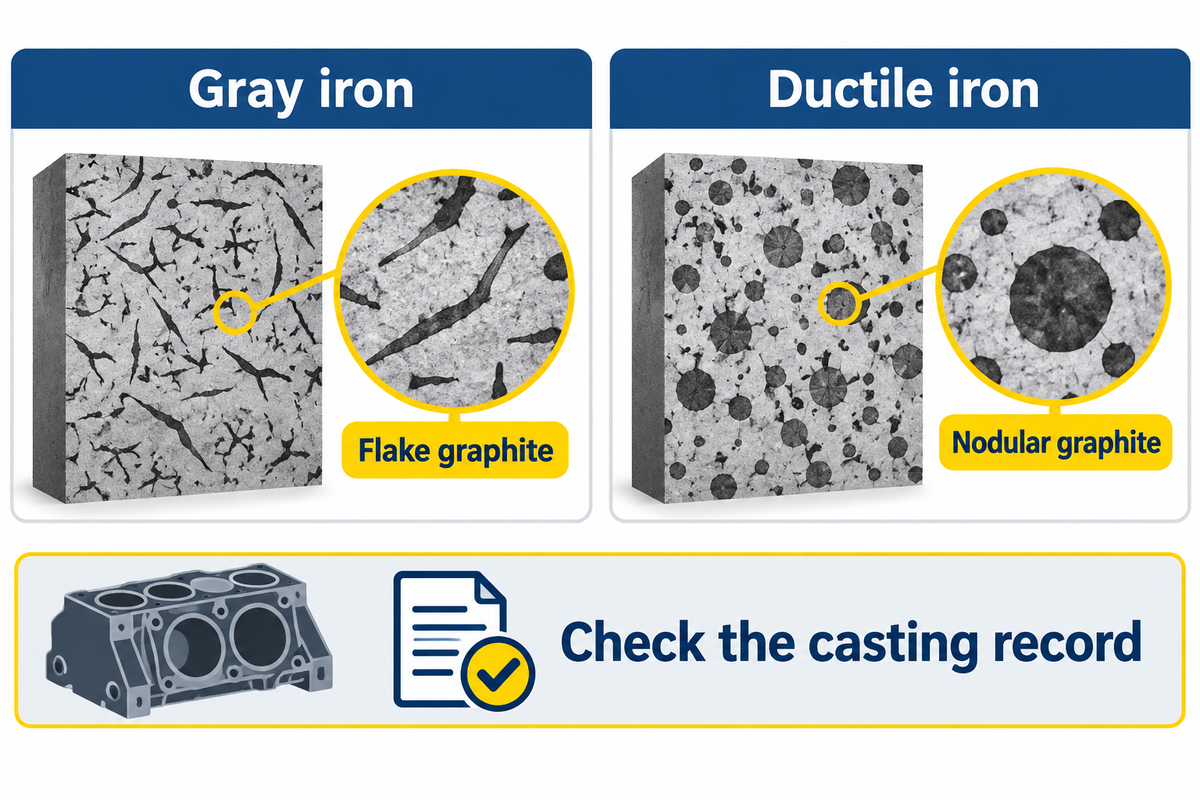
Several types of cast iron are candidates for weld repair, including some gray, ductile, and malleable grades. Begin with the material designation on the drawing, or a traceable casting record. Hold the part if the material can’t be determined, or if the repair affects a critical feature whose allowable condition is uncertain.
Graphite occurs in different forms in cast irons, including flakes in gray irons and nodules in ductile irons. Ductile irons commonly have nodular graphite in a ferritic or pearlitic matrix, and malleable cast irons have different heat-treated structures. The way carbon is distributed in irons with a high carbon content affects their weldability. TWI’s Review of Cast-Iron weldability explains how these differences affect how cast irons respond to changes in temperature.
Identify the crack and describe where it ends. For example, does it end in a thick boss? Does it cross a thin wall? Does it approach a precision seat? A nominally weldable grade still requires a viable route for joint preparation and measurement. There are valid reasons to avoid generalizing from repairs on other Cast alloys and Cast iron is a prime example. Oil can be a stubborn contaminant. If you need to weld cast iron from an oil-filled gearbox, document how the shop will check the workpiece after cleaning and before striking an arc.
Which cast iron cannot be welded?
White cast iron is usually not amenable to conventional fusion welding because of its hard and carbide-rich nature. If the casting is a wear part with an unknown or hardened surface, get the actual grade from the owner before assuming it’s gray iron. Other repair routes or alternatives may be the next option.
Why can the casting crack next to a nickel weld?
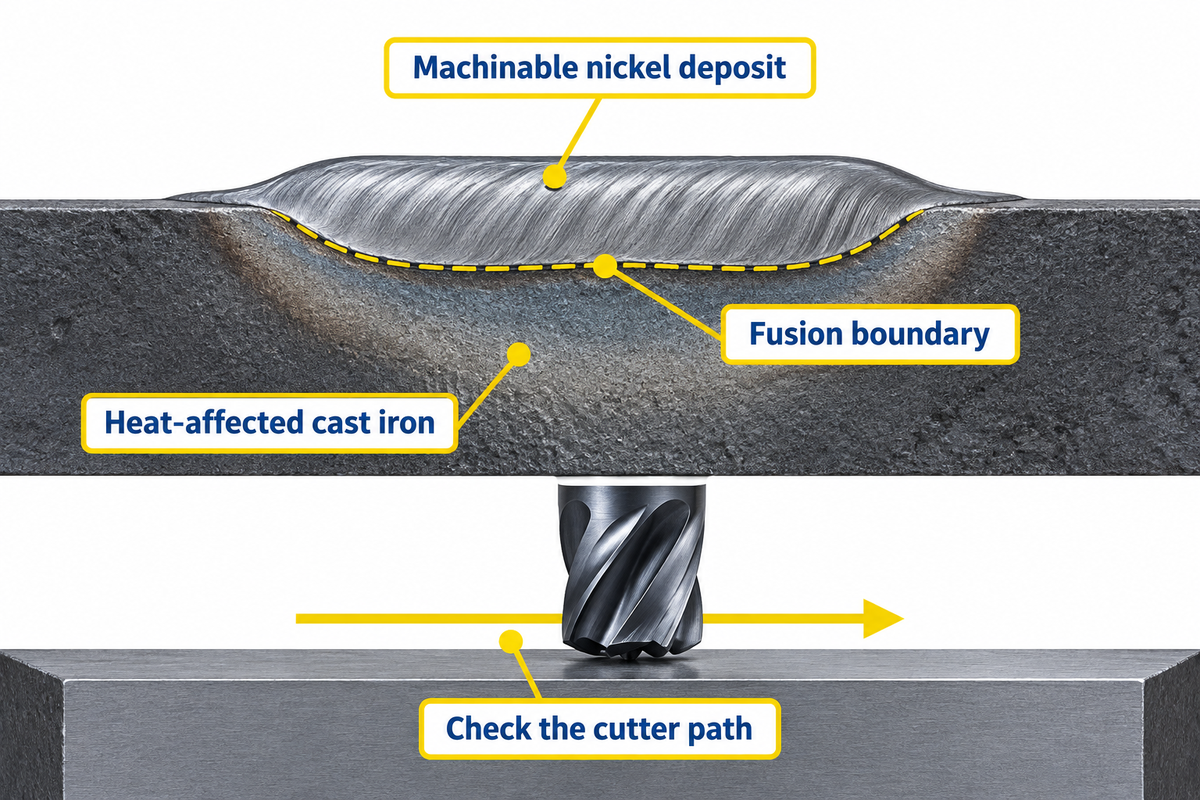
Nickel-based filler can leave ductile weld metal while the casting beside it forms hard and brittle phases. TWI identifies iron carbides and martensite as contributors to poor weldability. Uneven expansion and contraction add thermal stress. Restraint can leave internal stresses in the casting as the weld cools. Controlling the thermal cycle can help prevent cracking as the weld cools. It can’t eliminate the effect of a crack already present in the base metal.
- In the weld deposit, check how much casting metal enters the pool and if the deposited alloy can be machined.
- At the fusion boundary, the edge of the deposit is where the cutter moves between materials. Check it for visible or specified test indications after cooling.
- The heat-affected zone is the adjoining parent metal changed by the thermal cycle. It can be harder than the nickel deposit. It also warrants attention if restraint during cooling causes the cast iron to crack beside the bead.
Where is the hardest material after welding?
Hard material can be found at and slightly outside the fusion boundary. A study on gray cast iron welding by Pouranvari looked into different zones and found that using nickel filler alone didn’t eliminate hard phases outside the deposit. The study reports hardness readings and heat treatment conditions for its tested specimens. Zhouxiang’s guide to welding cracks also touches on the other defect types that appear in welding materials. For shop work, give the machinist the intended cutter path and let the procedure and inspection requirements govern the repair.
Which heat plan fits the casting?
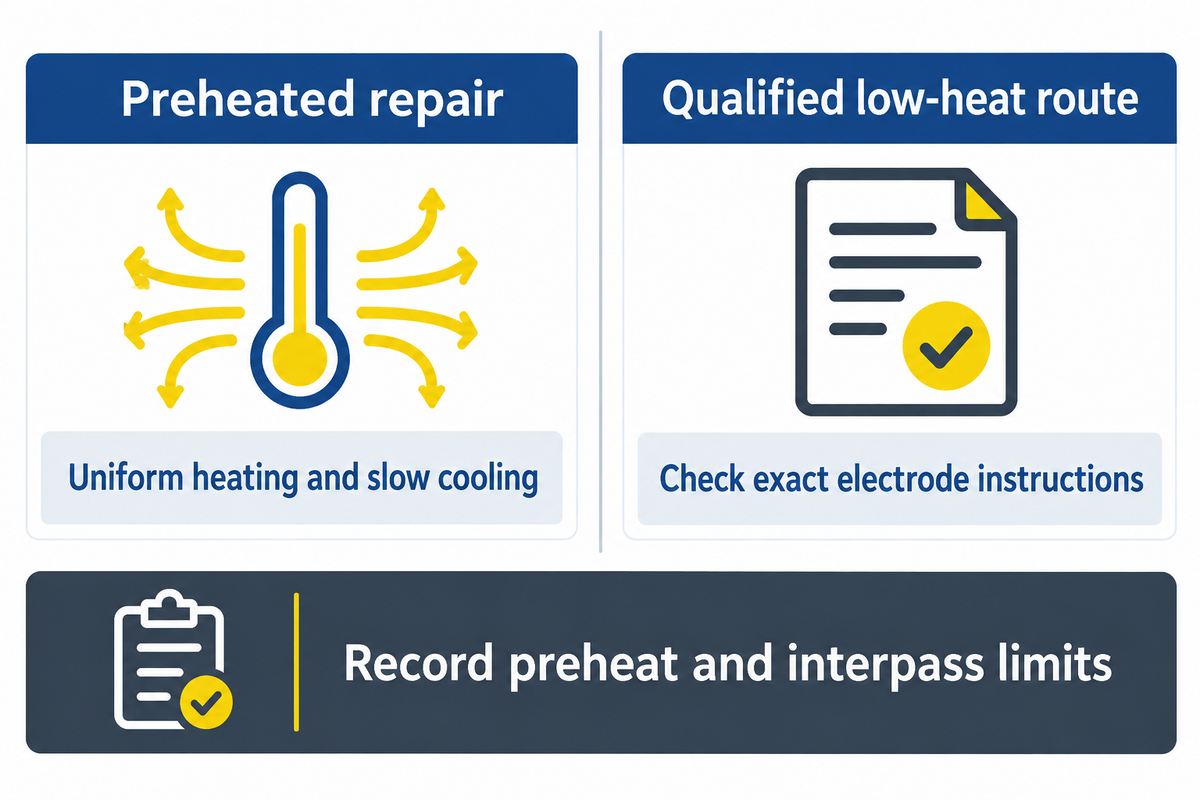
Use gradual heating and slow cooling for a preheated repair, or a qualified low-heat route if the procedure limits heat buildup; base the choice on the casting’s grade and geometry. A preheated route uses gradual heating and slow cooling to minimize thermal shock. Slow cooling reduces cracking risk under a suitable procedure. If the procedure requires it, preheat the cast iron uniformly and measure the specified locations prior to starting arc welding. A qualified low-heat route limits how much heat builds up in and around the repair. To minimize the risk of cracking during welding, specify where the welder measures temperature and what must be recorded between passes.
For example, TWI’s manual metal arc column gives typical preheat values of 300 °C (572 °F) for ferritic flake iron and room temperature to 150 °C (302 °F) for ferritic nodular iron. Read the row with its grade and method. A thick flange attached to a thin wall can heat unevenly, and neither figure sets a temperature for an unidentified component.
Record the drawing reference, temperature measurement points, preheat and interpass limits, weld sequence and cool down method. Heating one side of a casting can increase the risk of cracking if it leaves a sharp temperature gradient. Adjust for fixture restraint before adding heat. The approved procedure should indicate whether to peen the weld to relieve internal stresses. Peen the weld bead with a ball-peen hammer only when the procedure specifies it. The procedure should indicate which passes can be peened and when to peen them. Even a step intended to reduce internal stresses can’t correct a poor fit-up. A welder who can reach the groove, may still need access for a temperature measurement on the other side of the part.
Prepare the workspace, including enclosed areas, before heating. In U.S. general industry, OSHA’s welding, cutting and brazing standard requires venting hollow spaces, cavities, or containers prior to preheating, cutting or welding. Follow the facility’s hot-work, ventilation and fume controls. Keep chlorinated cleaning vapors away from the welding atmosphere.
Can you weld cast iron without preheating?
Yes, some gray iron repairs can use qualified low-heat welding techniques without preheating when the exact electrode’s instructions allow that thermal cycle. Lincoln Electric’s gray cast iron guidance separates this route from uniform preheating. It explains short weld passes and planned cooling intervals. Where the procedure requires short beads, weld in short, spaced segments and log the interpass measurements. Cooling too quickly or reheating a still-hot section can upset the intended thermal cycle. Either case can lead to cracking beside the deposit. Use the measured temperatures in the written procedure. Avoid changing methods in the middle of the repair.
Can you weld cast iron to steel with a nickel rod?
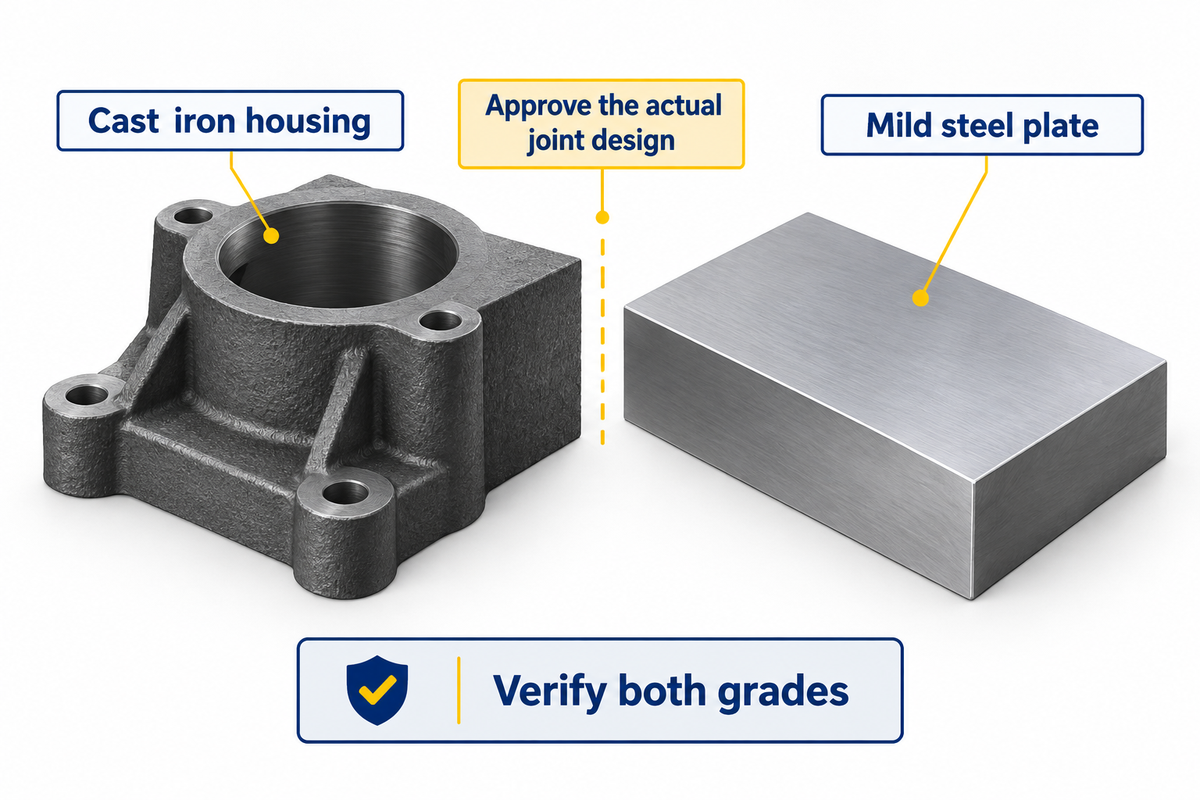
Yes, an appropriate ENiFe-CI covered electrode can be a candidate for joining cast iron to mild steel in some applications. Washington Alloy’s Nickel 55 product guide lists mild steel among its dissimilar joining applications. The suitability of any proposed joint depends on the actual cast iron, grade of steel, joint design and service.
ISO 15614-3 describes how a preliminary procedure for in-scope production or repair fusion welding is qualified by testing. Its principles also apply to joining steel to cast irons within its scope. Check the governing specification for the exact materials, variables and additional tests that apply.
What changes when the second part is mild steel?
The procedure must account for a second base metal and the restraint introduced by the joint. For a casting with a steel plate, include both grades, the casting and plate thicknesses, the joint drawing and the service loads on the repair form. The electrode supplier can confirm whether its nickel-iron electrodes cover both materials. Product information sometimes shows mild steel and stainless steel separately, so verify the actual grade. The repair authority must decide the disposition of the assembled joint.
What should pass before the repaired casting goes back into service?
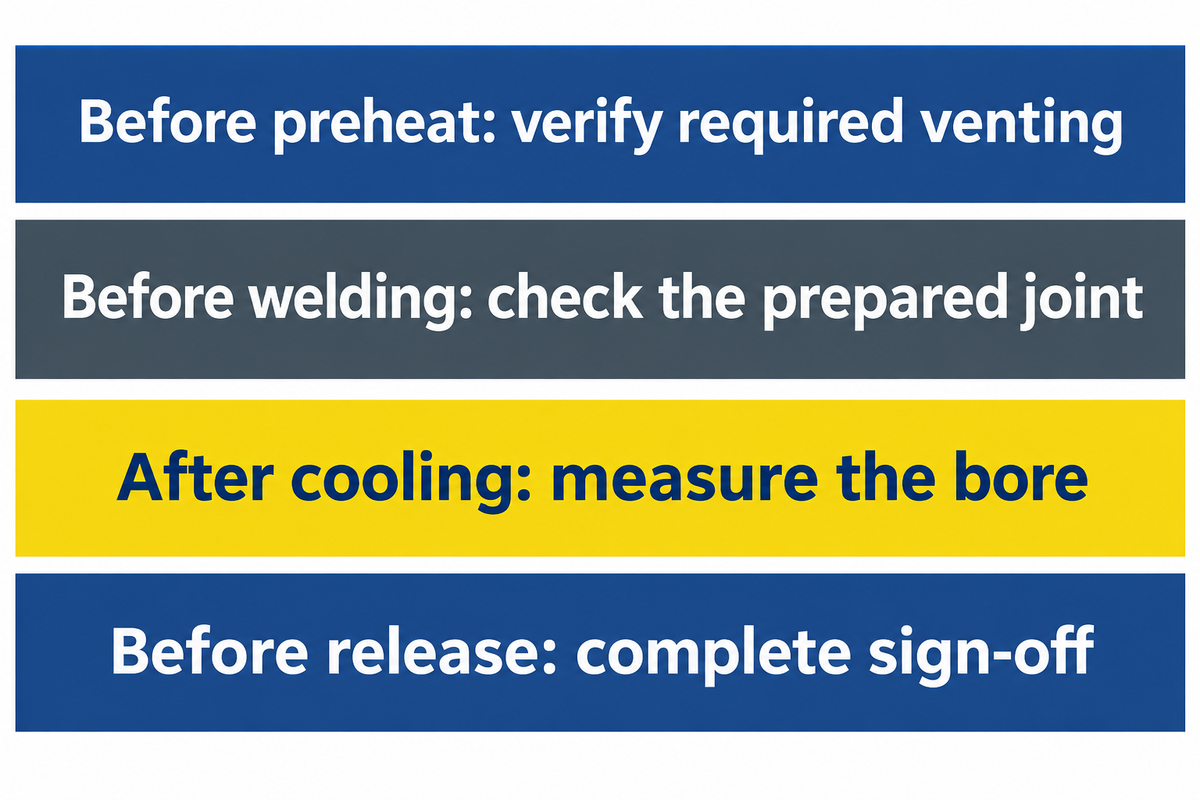
Check the cooled casting against the agreed crack acceptance criteria and dimensions before returning it to service. Before welding starts, the maintenance and quality teams should agree who makes each call and where the shop must pause. If the part is subjected to repeated loads and failure due to fatigue is a concern, the engineer should define how the proposed repair will be assessed for that service. Passing a bore measurement or surface examination doesn’t validate fatigue life.
| Repair process stage | Owner | Evidence to record | Reason to pause |
|---|---|---|---|
| Before quoting | Maintenance and engineering | Casting identification, duty, crack map, applicable repair limits | Unknown grade, unresolved critical service or signs that the damage extends beyond the proposed repair |
| Before welding | Weld supervisor and quality | Clean prepared joint, crack removal check, approved consumable and temperature controls | Contamination remains, a crack indication continues past the prepared area or the temperature cannot be managed |
| After cooling | Quality and machining | Specified examination, cooled bore size, shape and alignment, remaining stock | Rejectable indication or too little material to restore the required geometry |
| Before release | Responsible repair authority | Final measurements, specified tests, sign-off and reassembly conditions | Any repair requirement still open |
| At estimate handoff | Maintenance and purchasing | Written scope for machining, examination and reassembly | Quote omits an essential check, task or supplier qualification |
| Before preheat | Weld supervisor | Assigned temperature points, access and applicable hot-work controls | Required readings cannot be taken or required venting has not been verified |
| Between passes | Welder and weld supervisor | Consumable identification and temperature or sequence records from the procedure | An essential procedure condition drifts outside its limits |
| After machining | Machinist and quality | Finished bore geometry and any applicable follow-up examination | Remaining stock or finished geometry fails the drawing requirement |
Always scope the repair before deciding on a preparation method. The joint has to be free of contamination and defective material before welding. The cleaning or preparation method may also call for heat. Plan the post-weld examination before someone can grind the weld and alter the surface condition. TWI’s preparation guidance provides the reasons for needing to remove dirt, oil, and defective materials from the joint. If contamination or corrosion runs deeper than expected, work can pause to assess the material left after preparation.
How do you check whether a bore moved?
Measure the bore from the same references before welding and after the casting cools. On the gearbox housing, check the alignment between the two seats and the bore size. If there is too little stock to machine the bore, stop before cutting, even if the weld passes examination.
Put the bore on the job card. Ask the machinist to identify the measurements and minimum cleanup allowance before welding. The cooled inspection should tell the shop whether that allowance is still available.
When does replacement cost less than a nickel weld repair?
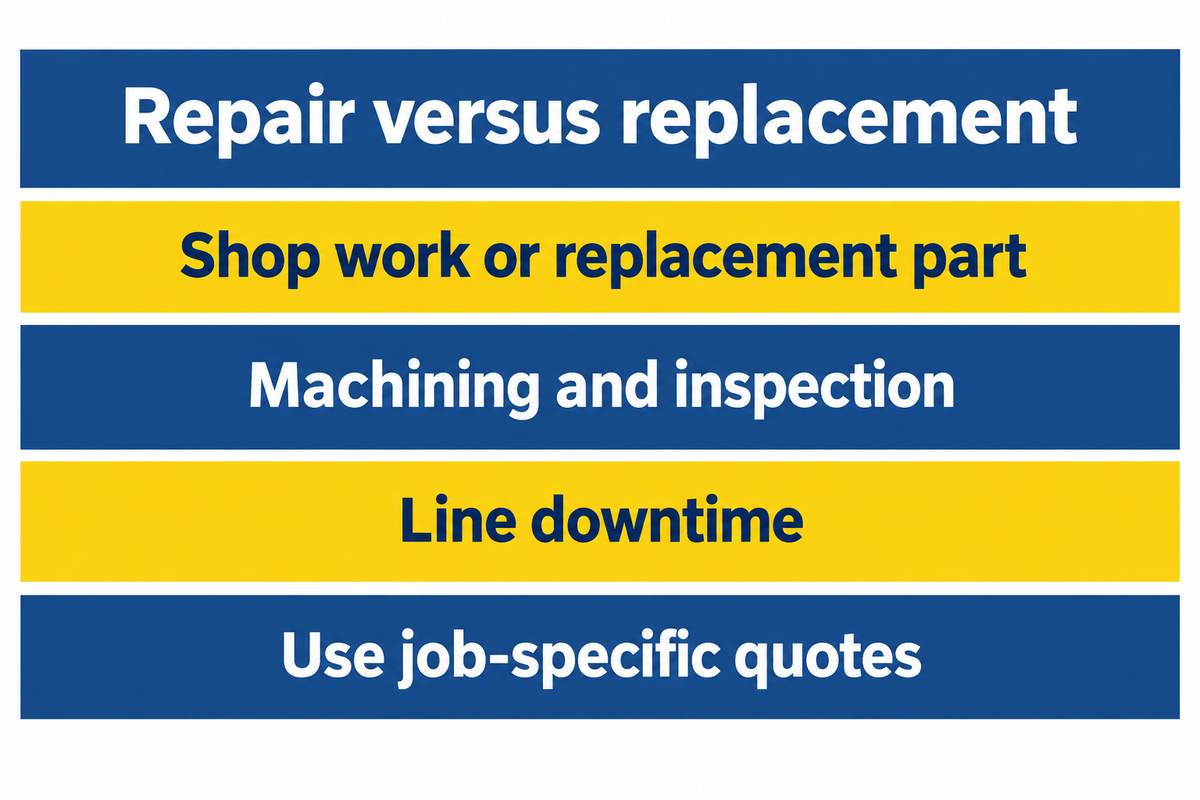
Replacement can cost less when repair adds hours of line downtime, machining or inspection. Compare costs only after engineering accepts each option for the part and its service. The gearbox housing is presumed to be non-critical. The worksheet provides some examples for cost and downtime calculations in US Dollars.
| Cost item | Repair | Replacement |
|---|---|---|
| Shop work or replacement part | $850 for preparation and welding | $2,100 for part, freight and fit |
| Machining and inspection | $500 combined | $150 for receiving inspection |
| Line downtime at $300/hour | 8 hours, $2,400 | 6 hours, $1,800 |
| Estimated total | $3,750 | $4,050 |
What if machining adds two hours?
Two extra hours of line downtime add $600 at the same rate. In this hypothetical example, without changing the original shop fee, repair rises to $4,350 and replacement is $300 cheaper. The worksheet arithmetic is 2 × 300 = 600, then 3,750 + 600 = 4,350 and 4,350 − 4,050 = 300. If machining happens while the line can run, count only the outage that affects production. Confirm which activities share the outage before comparing quotes.
What belongs on the electrode purchase order?
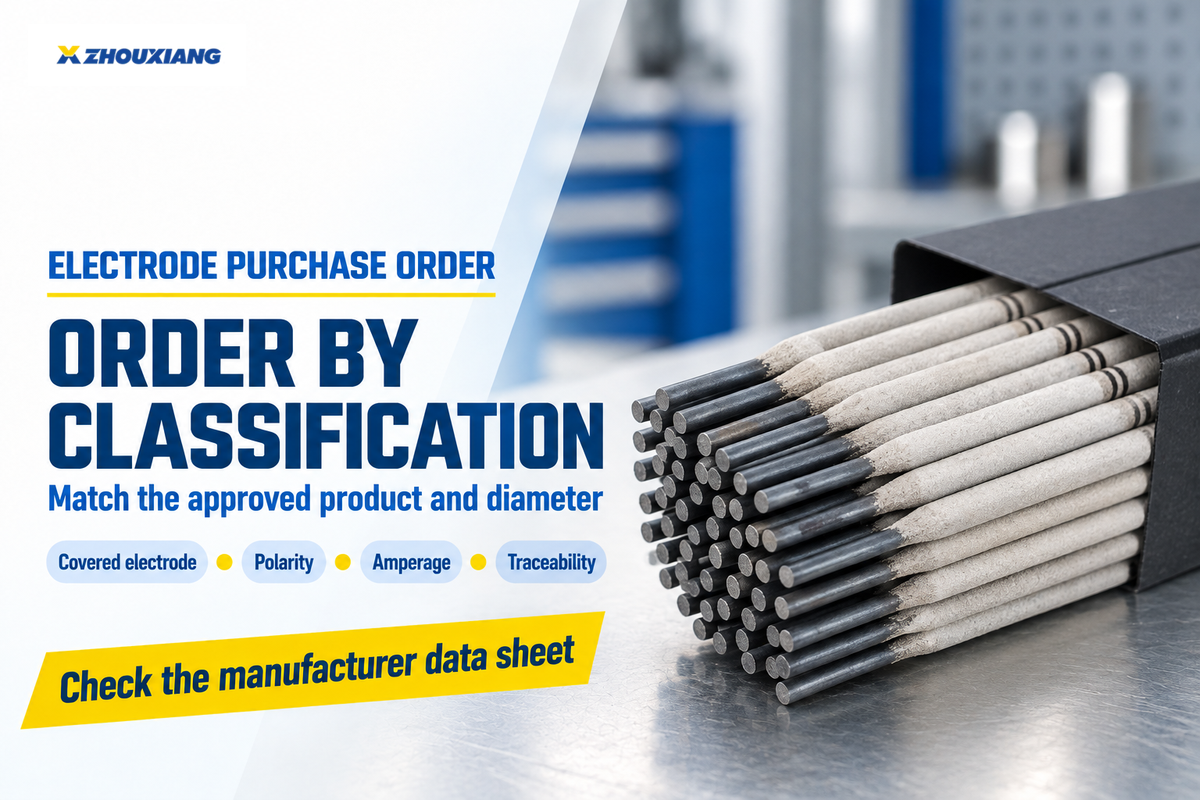
Indicate the covered electrode classification, approved product, diameter and traceability requirements. Attach the manufacturer data sheet and tie the requisition to the repair procedure. Procurement can compare availability and price while the welder checks the required polarity, amperage range and handling for that product.
Which details should match the electrode datasheet?
Check the electrode form, permitted current and polarity, diameter and storage instructions. Set the amperage from written work instructions for the approved consumable and joint. A bare filler rod for TIG welding and a flux covered stick electrode can both be advertised as nickel rods. An ordinary package of steel rods is likewise a different consumable from a product explicitly classified for this repair. The covered electrode has a different job in the arc and produces slag. For a refresher on the process itself, see Zhouxiang’s stick welding methods guide. Request a substitution review when the offered product differs from the approved specification.
Frequently Asked Questions
What is the number of a cast iron welding rod?
Two covered classifications are ENi-CI and ENiFe-CI. The packages may also say Nickel 99 or Nickel 55, depending on the product. Read the classification and trade designation together before purchase. Then use the product’s datasheet to confirm the welding process, diameter and compatible current for the repair procedure. Keep those details with the purchase order.
How can you tell cast iron from cast steel?
Confirm the material through the drawing, foundry marking, part record or a material identification process accepted by the repair authority. Both metals can have a rough surface from casting, so appearance alone can mislead. Pay particular attention when an archived drawing covers several revisions or a replacement part has a different supplier.
Can you weld malleable iron?
Yes, some malleable irons can be welded when the grade and procedure are known. TWI’s cast iron guide distinguishes blackheart from whiteheart malleable iron. Whiteheart can have a higher-carbon core than its surface, which makes penetration an important part of the procedure decision. Identify the casting before transferring a gray iron repair plan. Record the casting identification on the job sheet.
Can you use a nickel TIG rod in a stick welder?
Use a covered stick electrode for stick welding. A bare nickel TIG rod is a filler for a different welding process. Check the label for the form and classification, particularly when the same nominal nickel content appears on both packages.
What are nickel welding rods used for?
Covered nickel electrodes are used for some cast iron repairs and dissimilar joints. The choice depends on the exact classification and product. For example, the Washington Alloy Nickel 99 datasheet points to thin cast-iron sections where machining matters. Within the product’s intended range, that can help a shop plan a milled face or a tapped hole. Keep the cutter clear of unassessed hard areas. For a repaired bearing seat, the surrounding cast iron still needs its own dimensional and material checks.
Can you wire weld cast iron?
MIG welding cast iron is possible with a suitable procedure for the grade and repair. TWI covers MIG and flux-cored processes among the options. Process variables differ from stick welding, including shielding gas when used. See how wire-fed welding works for a process overview.
Can you machine across a repaired cast iron bore?
Yes, you can machine some repairs when the qualified route allows it and enough stock remains to restore the bore. Plan the cut through the weld deposit and across the casting-side transition. The deposit may cut cleanly while the heat-affected iron remains hard. Agree with the machinist on references, alignment and stock allowance before welding, then repeat measurements after cooling to see whether the shape can still be restored within the drawing limits. Save the before-and-after measurements with the final inspection report.
Plan the casting repair before ordering the rod
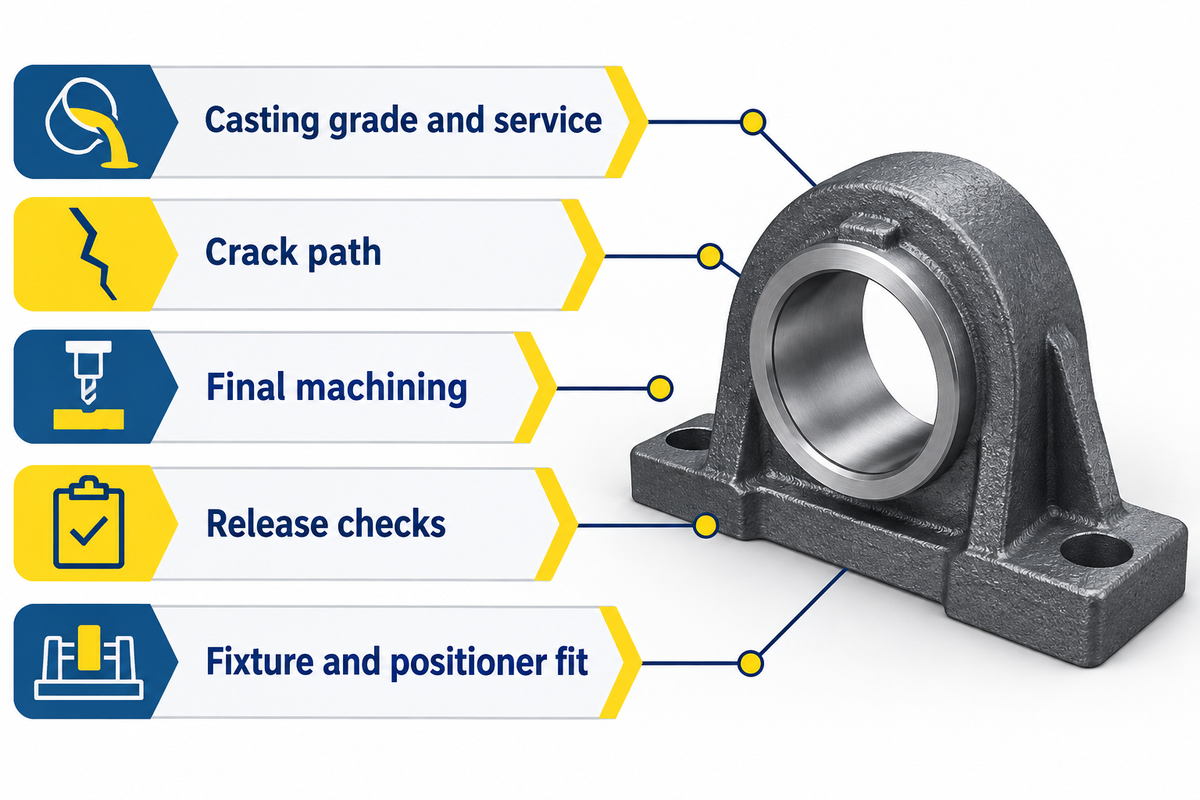
Using the right electrode starts with a repair brief. List the casting grade, service, crack path, final machining and checks required for release. Compare repair and replacement only after the technically acceptable routes are clear. If the approved repair procedure permits repositioning the casting, compare the workpiece and fixture weight with the positioner load and table specifications.
References & Sources
- American Welding Society. A5.15:1990(S2023), specification for cast iron welding electrodes and rods.
- International Organization for Standardization. ISO 15614-3:2008, fusion welding procedure tests for cast irons.
- TWI. Weldability of materials: cast irons.
- TWI. Preparing cast iron for welding.
- Lincoln Electric. Choosing stick electrodes for welding cast iron.
- Lincoln Electric. Guidelines for welding cast iron.
- Pouranvari. On the weldability of grey cast iron using nickel based filler metal.
- OSHA. 29 CFR 1910.252, general requirements for welding, cutting and brazing.