Technical Review: Reviewed by the Wuxi Zhouxiang Complete Set of Welding Equipment Co., Ltd. technical team
Updated: November 2026
Flux for submerged arc welding is a granular mineral blanket fed ahead of a continuous wire electrode. It buries the arc, blocks atmospheric contamination, stabilizes current, and forms protective slag. For multi-pass thick carbon or low-alloy steel, use a neutral or basic agglomerated flux in a qualified AWS A5.17/A5.17M:2025 or AWS low-alloy flux-wire pair (with the flux classified separately under ISO 14174). Limit active flux to single-pass steel with light scale. Store sealed bags at or below 70% RH, redry damp basic flux at 300–350 °C in trays up to 50 mm deep, and blend at least 1 part virgin flux to 3 parts recycled flux.
In contrast to stick electrodes or gas shielded wires, submerged arc welding segregates the filler wire from the flux. That segregation enables fabricators to adjust the bead geometry, deoxidation, and sub-zero impact toughness independently. But it presents a genuine procurement hazard.
Buyers often match a five-character AWS code without regard to basicity, post-weld heat treatment (PWHT) strength degradation, or vacuum recovery ceilings.
Key Specification Takeaways
- Decouple metallurgical activity from slag basicity: AWS neutrality requires a Wall Neutrality Number at or below 35, in contrast to the Boniszewski Basicity Index (BI), which tracks slag oxide ratios. A flux may simultaneously be AWS-neutral and have high basicity.
- Never substitute flux by AWS code alone: more than eight commercial pairings share AWS F7A2-EM12K yet encompass both active single-pass grades and neutral multi-pass grades.
- Budget net fresh makeup instead of gross hopper flow: recent U.S. distributor listings ran $111.76–$165.01 per 50 lb carbon-steel bag, while lower factory FIBC bulk rates require annual supplier contracts.
- Control moisture and fines together: unheated hoppers and oil-laden recovery air drive hydrogen into the weld, while powdery fines below 0.5 mm trigger surface pockmarking.
What Does Flux for Submerged Arc Welding Do, and How Does It Differ from Stick or Flux-Cored Wire?
Granular SAW flux guards the molten pool, stabilizes the arc, deoxidizes or alloys the weld, generates slag, and captures the fumes as a loose blanket supplied independently of the wire. Granular flux can’t be replaced by stick coatings or flux-cored wires since SAW entombs the electric arc in loose mineral granules. In the submerged arc process, a welding head feeds a continuous bare wire electrode into granular flux poured onto the workpiece.
What Is the Main Function of Granular Flux in the Submerged Arc Process?
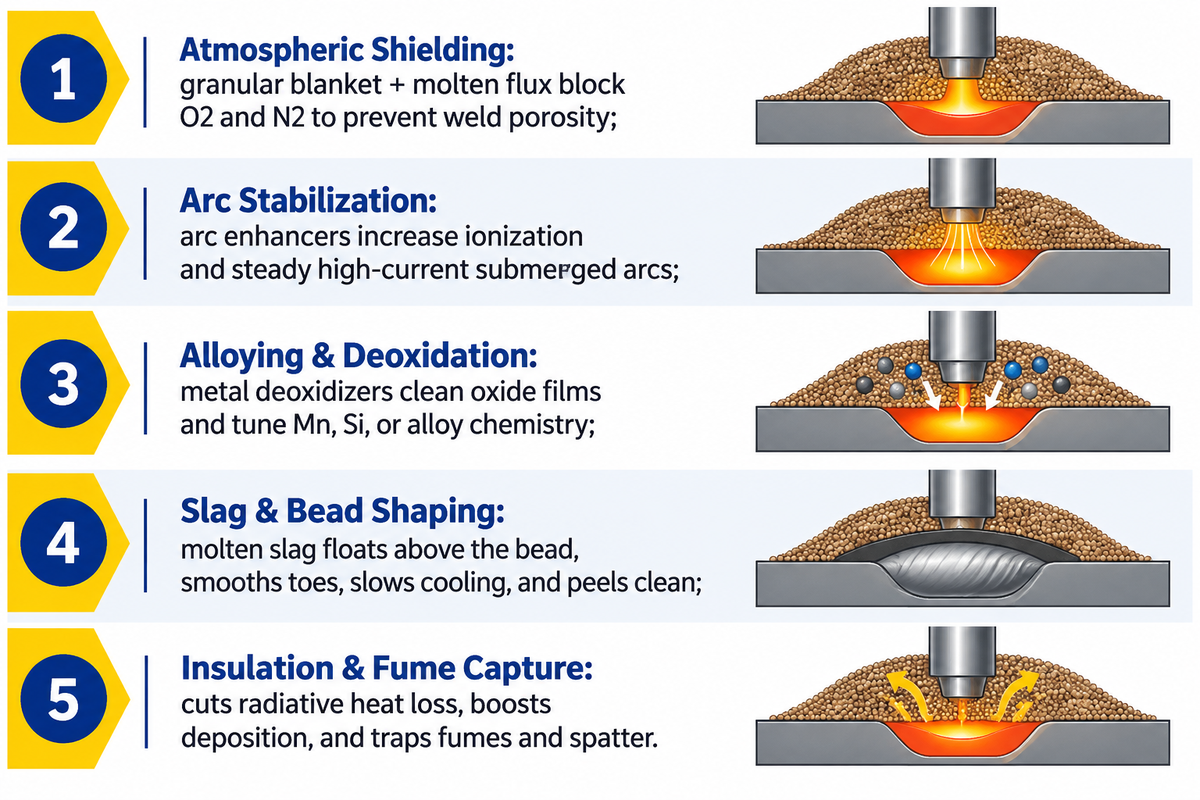
The primary role of flux in the submerged arc process is isolating the molten weld pool from oxygen and nitrogen while shaping slag chemistry and arc stability. According to The Welder’s analysis by ESAB engineers David Meyer and Robert Koltz, every qualified SAW flux delivers five linked functions:
- The shielding effect of the granular blanket and the underlying molten flux layer blocks atmospheric contamination, thereby avoiding nitrogen pick-up and the formation of gross weld metal porosity.
- Inside the flux composition, there are arc stabilizers (called arc enhancers) that support increased ionization and stabilize arc processes at high welding currents.
- Alloying and deoxidation involve the use of metal deoxidizers to remove thin oxide films from the base metal while certain grades will add manganese, silicon, or alloying elements.
- The formation of slag and bead shaping allows molten slag to float over the solidifying weld bead, smooth the weld toes, decelerate the cooling, and peel off neatly during the slag removal.
- Heat insulation and fume suppression reduce radiative heat loss, increase the deposition rates, and capture the welding fumes and spatter under the layer of flux.
A two-piece arrangement separates SAW welding from other arc welding processes. In shielded metal arc welding (SMAW, or manual metal arc), flux is fixed onto a short core wire and caps the duty cycle. In flux-cored arc welding and gas metal arc welding, flux sits inside a tubular core or is replaced by shielding gas.
Both designs expose the arc to spatter and drafts. As TWI Global Job Knowledge 87 observes, the SAW process uniquely provides filler wire and granular flux independently. That configuration benefits high-current flat and horizontal welding operations, but it mandates strict flux handling.
Types of SAW Flux: Fused vs. Agglomerated and Active vs. Neutral vs. Basic
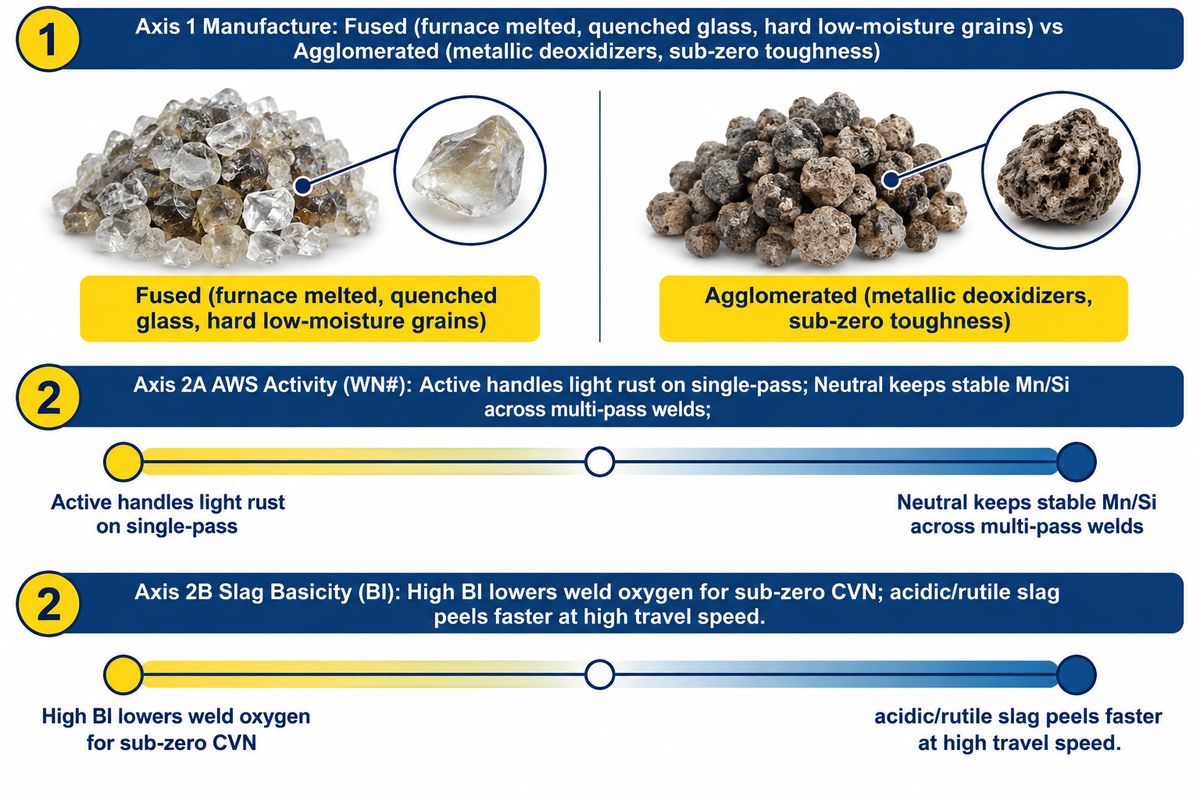
A commercial SAW flux divides along two orthogonal axes: the grain manufacture axis and the molten slag chemistry axis. The manufacture axis divides into fused, agglomerated, and mechanically mixed. The chemistry axis divides into AWS activity (active, neutral or alloying) and slag basicity.
Buyers often conflate these two axes and take “basic” and “neutral” to be mutually exclusive.
Flux-Activity & Basicity Two-Axis Selector
Run two independent checks before shortlisting any flux composition:
- Axis 1 – Production technique (fused vs. agglomerated): select fused fluxes when high-current consistency, moisture resilience, and grains hard enough to survive vacuum reprocessing matter most; opt for agglomerated fluxes when lower weld oxygen, metallic deoxidizers, or low-temperature toughness is preferred.
- Axis 2A – AWS Metallurgical Activity (WN#): confirm whether manganese and silicon shift with arc voltage. Active fluxes are capable of enduring light surface rust on single pass welds, while the neutral fluxes uphold the consistent weld metal chemistry throughout unlimited multi-pass deposits.
- Axis 2B – Boniszewski Basicity Index (BI): check the numeric oxide ratio on the datasheet. High basicity will lower weld oxygen and increase sub-zero impact toughness while more acidic or rutile slags peel faster at higher travel speeds.
The table below compares nine different generic SAW flux types in terms of manufacturing method, slag chemistry, fundamental properties, and application limits.
| Type | Manufacturing | Activity / Slag Behavior | Primary Strength | Key Limitation |
|---|---|---|---|---|
| Fused Acidic / Manganese Silicate (MS) | Furnace melted, quenched, crushed | Active; acidic slag | High current stability, non-hygroscopic, durable grains | High weld oxygen limits sub-zero toughness; voltage-sensitive Mn/Si |
| Fused Neutral / Calcium Silicate (CS) | Furnace melted, quenched, crushed | Neutral; low Mn/Si swing | Chemically uniform; resists moisture and recycling wear | Lacks metallic deoxidizers; poor tolerance for heavy mill scale |
| Agglomerated Active (MS / AR) | Silicate-bonded, low-temp baked | Active (high WN#); added Mn/Si | Cleans light rust and mill scale; fast fillet travel speeds | Unsuitable for thick multi-pass plates due to cracking risk |
| Agglomerated Aluminate-Rutile (AR) | Silicate-bonded, low-temp baked | Neutral to mildly active; acidic-neutral slag | Smooth bead appearance and easy slag peeling in fillets | Moderate impact toughness; hygroscopic if left open |
| Agglomerated Aluminate-Basic (AB) | Silicate-bonded, low-temp baked | Neutral; basic slag | Balanced multi-pass toughness and good slag detachability | Requires dry storage, heated hoppers, and fines screening |
| Agglomerated Fluoride-Basic (FB) | Silicate-bonded, low-temp baked | Neutral; highly basic CaF2/MgO slag | Lowest weld oxygen and top low-temperature impact/CTOD toughness | Poorer high-speed bead wetting; strict moisture control required |
| Agglomerated Alloying / Hardfacing | Silicate-bonded with alloy powders | Alloying (Cr, Mo, Ni, or wear alloys) | Delivers alloy or hardfacing chemistry with lower-cost carbon wire | Deposit chemistry shifts sharply if arc voltage fluctuates |
| Mechanically Mixed Flux | Dry blend of fused or bonded grades | Varies with blend ratio | Custom balance of cost and operability for specialty lines | Grains can segregate by density during transport or vacuum recovery |
| High-Speed Multi-Arc / Two-Run Flux | Agglomerated (often AB or Ti-B tuned) | Neutral; fast-freezing slag | Holds bead profile at high travel speeds and single-pass-per-side dilution | Must hold a two-run (T) qualification for code impact requirements |
Fused vs. Agglomerated SAW Flux: Which Wins on Moisture, Toughness, and Vacuum Recycling?
The fused fluxes excel in water resistance and vacuum-recycling grain strength while the agglomerated fluxes have higher performances in metallic deoxidation and impact toughness at low temperatures. Raw materials for fused fluxes are melted in a furnace, quenched into glass, and crushed to sized grains. The temperature in the furnace is so high it will oxidize the metallic deoxidizers, so fused fluxes can’t carry free silicon or manganese cleansers for rusted plate.
Experimental data in Nippon Steel patent US4221611A explain the toughness trade-off directly. Inventors tested 40 horizontal flux formulations at 350 A, 27–28 V, and 50 cm/min with 3.2 mm wire. Conventional fused fluxes rely on SiO2 and MnO for easy melting. Those unstable oxides dissociate in the arc and drive oxygen into molten steel. Non-fused agglomerated formulas add CaF2 (5–50%, optimal 10–26%) and MgO (20–40%) while capping SiO2, which cuts weld-metal oxygen sharply. Controlled TiO2, Al2O3, and B2O3 refine microstructure for sub-zero Charpy and COD toughness, though CaF2 above 26% destabilizes the arc.
Unfortunately, the cost of this flexibility is paid on the shop floor. Low temperature cured grains are held in a bond by a potash or soda silicate binder. Consequently, agglomerated fluxes take up moisture at a faster rate and disintegrate to fines at a quicker rate within the vacuum recovery system.
Match the fused or agglomerated flux route with your primary hazard. Heavy recycling wear favors fused grades, while sub-zero toughness or light mill scale is more suited to agglomerated grades.
Key Factors When Choosing Submerged Arc Welding Flux: Basicity Index, AWS A5.17:2025, and ISO 14174
Before approving a flux, four parameters need to be checked in order: the governing standard, the Wall Neutrality Number, the numerical Basicity Index, and the joint thermal condition. The most frequent specification error in SAW welding is the adoption of an AWS classification string as an off-the-shelf substitute.
Basicity Index and Arc-Voltage Chemistry Sensitivity
Flux activity and slag basicity measure two different physical effects. As Lincoln Electric application engineer Ken Mui explains in Canadian Fabricating & Welding, AWS A5.17 sets active versus neutral status through the Wall Neutrality Number:
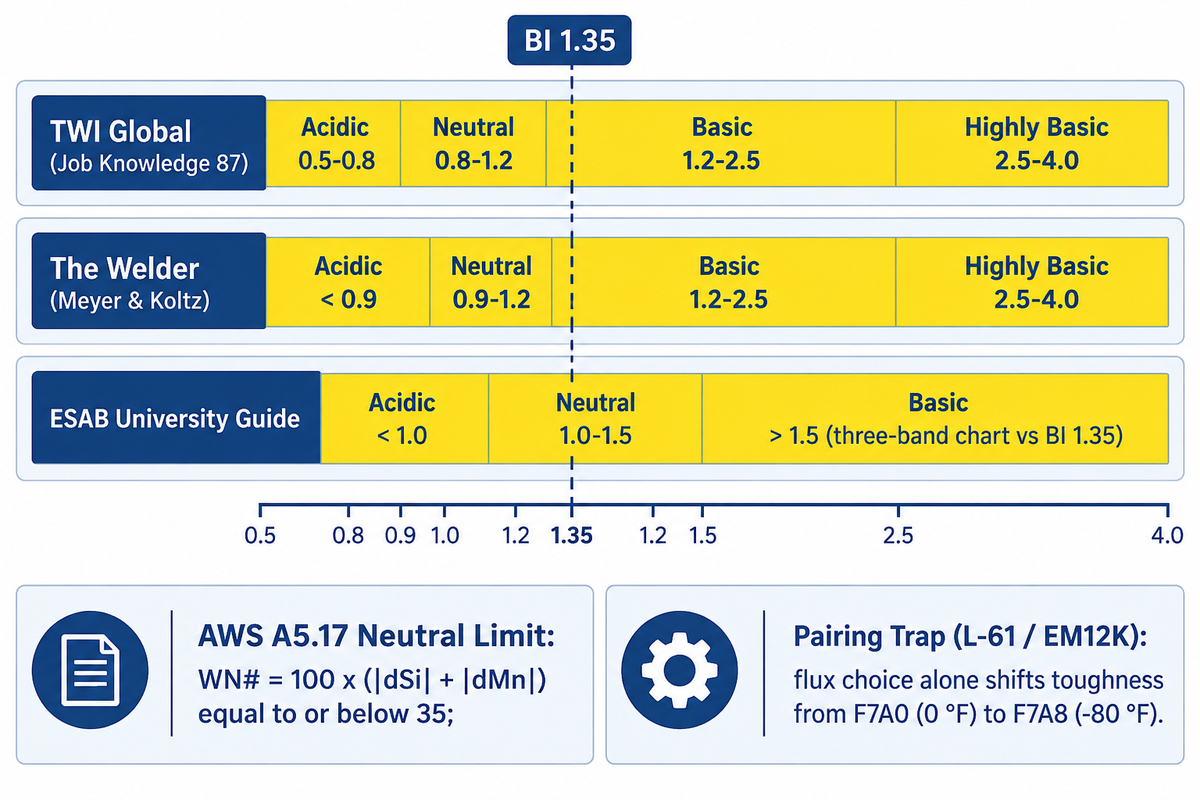
With WN# = 100 × (|ΔSi| + |ΔMn|), flux according to AWS A5.17 is considered neutral when WN# is equal to or below 35 over the arc voltage test range.
Conversely, the basicity index evaluates oxide chemical composition according to the proportion of basic to acidic oxides in the flux. The Boniszewski formula is used by both TWI Global and Lincoln Electric:
BI = [CaO + MgO + Na2O + K2O + CaF2 + 0.5(FeO + MnO)] / [SiO2 + 0.5(TiO2 + ZrO2 + Al2O3)]
Instead of relying on verbal category descriptors, aim for a numeric Basicity Index (BI) of 1.2-2.5 for basic, or 2.5-4.0 for highly basic toughness. Three main welding guides provide different cut-offs on the same scale:
| Published Reference | Acidic Band | Neutral Band | Basic Band | Highly Basic Band |
|---|---|---|---|---|
| TWI Global (Job Knowledge 87) | 0.5–0.8 | 0.8–1.2 | 1.2–2.5 | 2.5–4.0 |
| The Welder (Meyer & Koltz) | < 0.9 | 0.9–1.2 | 1.2–2.5 | 2.5–4.0 |
| ESAB University (SAW Flux Guide) | < 1.0 | 1.0–1.5 | > 1.5 | Not applicable |
A flux with a BI of 1.35 classifies as “basic” under TWI and The Welder, in contrast to ESAB’s three-band chart. This can be resolved by considering its exact BI number in conjunction with matched Charpy V-notch results.
Decoding AWS A5.17:2025, AWS A5.23, and ISO 14174 Designations
Under AWS A5.17/A5.17M:2025 (carbon steel) and AWS A5.23/A5.23M:2025 (low-alloy and high-manganese steel), SAW flux doesn’t receive a standalone AWS classification. Flux is only classified by AWS in terms of the mechanical properties from the relevant bare wire electrode or metal cored wire. Note the U.S. Customary (A5.17) tables aren’t interchangeable with the SI metric (A5.17M) tables.
International projects instead use ISO 14174. ISO 14174 classifies flux independently by manufacturing route and chemical type, such as MS (manganese silicate), CS (calcium silicate), AR (aluminate rutile), AB (aluminate basic), or FB (fluoride basic), separate from the paired welding wire.
Worked Example 1 – Reading AWS A5.17/A5.23 Codes, PWHT Drop, and Two-Run Suffixes
- As-welded carbon steel (F7A4-EM12K-H8): F denotes flux, 7 denotes 70 ksi minimum tensile strength, A means as-welded, and 4 requires 20 ft-lbf (27 J) Charpy impact at -40 °F (-40 °C). EM12K names the paired wire, while H8 caps diffusible hydrogen at 8 mL/100 g.
- Measured PWHT strength drop: published OEM mechanical data for Lincolnweld 860 with L-61 wire list F7A4-EM12K-H8 as-welded (420 MPa yield, 510 MPa tensile, 145 J at -40 °C). After 1 hour at 620 °C (1,150 °F), the same pairing drops to F6P5-EM12K-H8 (370 MPa yield, 480 MPa tensile), and longer PWHT hold times lower strength further.
- Two-run weld code (F7TA4-EM12K): the letter T under AWS A5.23 certifies two-run (one pass each side) welds common in pipe mills, ship panels, and wind towers. As two-run beads don’t have the grain refinement of multi-pass welds and carry higher base metal dilution, multi-pass CVN values overstate two-run toughness.
Wire-Flux Pairing, Travel Speeds, and Code Substitution Traps
Never consider two filler metals with the same AWS classification interchangeable. Canadian Fabricating & Welding reports that Lincoln Electric supplies more than eight flux pairings for L-61 (EM12K) under AWS F7A2-EM12K. One pairing (Lincolnweld 761/L-61) is an active flux for single-pass seams over light scale. Another (Lincolnweld 960/L-61) is a neutral flux for heavy multi-pass plate.
Changing flux alone on L-61 alters qualified toughness from F7A0 (0 °F) to F7A8 (-80 °F). On code jobs, swapping flux trade names or from neutral to active demands requalification of the procedure.
Which SAW Flux Fits Your Application? Material, Joint, and Production Line Selection Matrix
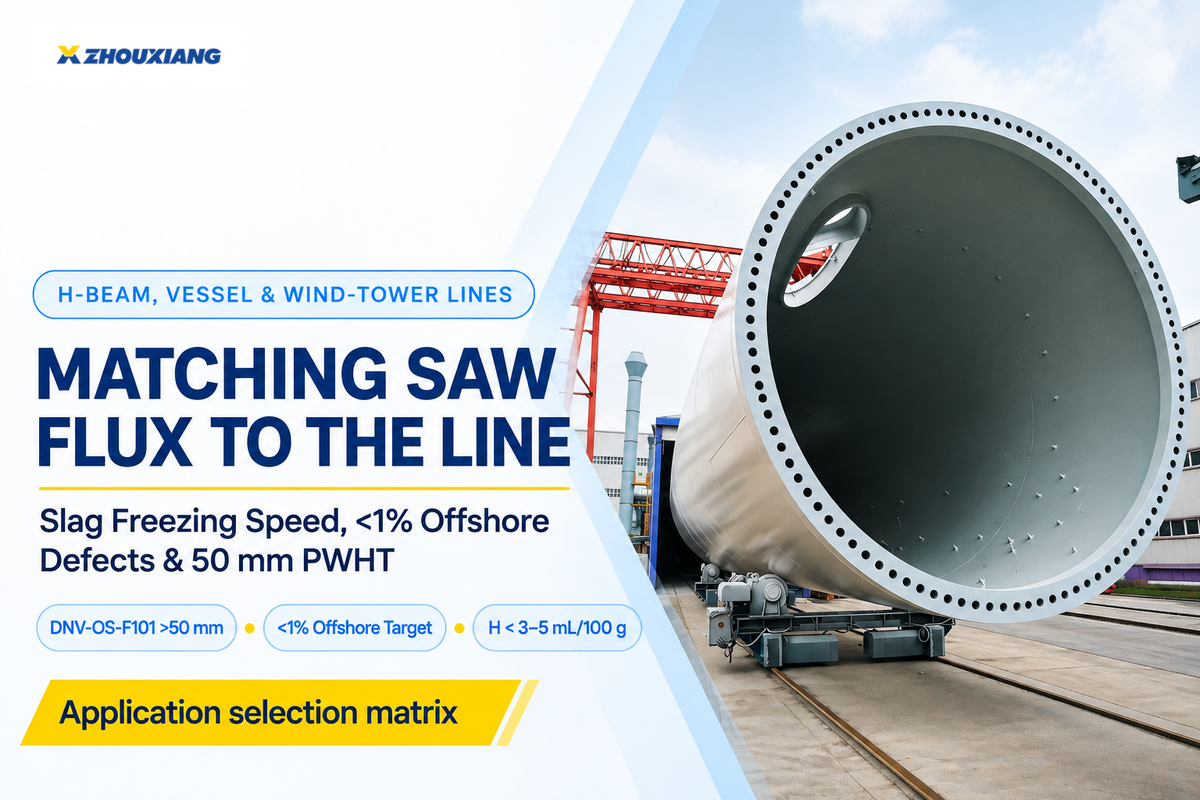
Choose an active agglomerated flux for single-pass plate with light scale, a neutral basic flux (WN# 35 or lower) for multi-pass or sub-zero joints, or a fused grade for high-abrasion recovery. Choosing the right flux also balances slag freezing speed with joint configuration and travel speeds. To select the best flux for your floor, the table below correlates nine industrial conditions with generic flux families and clear exclusion limits.
| Application Scenario | Recommended Flux Family | Typical Wire Pairing | Key Process Target | Limitations / Not Suitable When |
|---|---|---|---|---|
| Automated H-beam fillet welding (single/twin pass) | Agglomerated neutral AR or fast-freezing AB | EM12K / EL12 solid wire | High travel speed, clean self-peeling slag, flat 2F fillet toes | Avoid sluggish high-basicity FB flux if travel speed exceeds slag wetting window |
| Single-pass carbon plate with light rust or mill scale | Active agglomerated (high Mn/Si deoxidizers) | EL12 / EM12K solid wire | Porosity resistance over minor scale; high speed | Do not use on thick multi-pass plates or code joints with tight Mn/hardness limits |
| Thick pressure vessels (multi-pass + PWHT) | Neutral agglomerated AB or FB (low-H) | EM12K / EH11K / EA2 | Stable Mn/Si across passes; qualified P-condition tensile & CVN | Requires cleaned bevels; verify exact PWHT temperature and hold duration |
| Offshore platforms & sub-zero CTOD structures | Moisture-resistant fluoride-basic (FB) | Low-alloy Mn-Ni / Ti-B wire | Diffusible H < 3–5 mL/100 g; as-welded CTOD at -10 °C to -40 °C | Sensitive to humidity; avoid unheated hoppers in marine air |
| Wind-tower longitudinal & circumferential seams | Neutral AB or FB (with two-run T cert if 2-pass) | EM12K / ENi1K / tandem wire | Sub-zero CVN toughness under high deposition rates | Never extrapolate multi-pass CVN data to two-run shell welds |
| Pipe mill two-run seam welding | Two-run qualified neutral AB (AWS T suffix) | EM12K / EA2TiB | High dilution tolerance and unrefined-zone toughness | Most standard multi-pass fluxes fail two-run impact specs |
| Deep narrow-groove butt welds | Agglomerated AB with self-detaching slag | Matched carbon or Cr-Mo wire | Reliable slag release between steep sidewalls | Avoid high-CaCO3 + TiO2 formulas that form sticky CaO·TiO2 slag |
| Sour service (H2S) pipelines & vessels | Neutral low-H basic flux (AB / FB) | C-Mn or ≤ 1% Ni alloy wire | Controlled hardness and NACE MR0175 / ISO 15156 1% Ni cap | Reject high-nickel wires exceeding 1% deposit Ni |
| Weathering steel (A588) & stainless cladding | Neutral carbon-steel flux (A588) or Cr-compensating basic stainless flux | Weathering or 308L/309L wire | Color/corrosion match on A588; low chromium burn-off on stainless | Do not run acidic carbon-steel flux on austenitic stainless steel |
In offshore fabrication, flux design directly controls inspection risk and the cost of furnace treatments. Lincoln Electric engineers Ben Schaeffer and Teresa Melfi report in the AWS Welding Journal that offshore clients typically target weld defect rates of less than 1%. Under Offshore Standard DNV-OS-F101, C-Mn and low-alloy joints above 50 mm thick require PWHT unless as-welded CTOD fracture toughness passes.
Using a low-hydrogen basic flux designed for high-deposition, unrefined weld beads may enable the qualification of as-welded thick sections, thereby negating the need for furnace-based stress relief.
How Flux Choice Interacts with Automated H-Beam and Wind-Tower SAW Lines
Automated fabrication lines magnify any mismatch between flux grain size, slag freezing speed, and mechanical delivery hardware. Wuxi Zhouxiang Complete Set of Welding Equipment Co., Ltd. manufactures the integrated H-beam submerged-arc welding line series PHJ0815 and PHJ0820 alongside wind-tower submerged-arc welding production lines , supplying the automated welding machinery rather than flux consumables:
| Zhouxiang H-Beam Line Model | Web Height × Thickness | Flange Width × Thickness | Beam Length | SAW Configuration & Speed |
|---|---|---|---|---|
| PHJ0815 | 160–1,500 mm × 6–16 mm | 150–800 mm × 6–25 mm | 6,000–15,000 mm | Single-arc double-wire SAW; 0.35–3 m/min; 2 operators |
| PHJ0820 | 200–2,000 mm × 6–30 mm | 200–800 mm × 8–40 mm | 6,000–15,000 mm | Single-arc double-wire SAW; 0.35–3 m/min; 2 operators |
At upper H-beam carriage speeds, flux delivery height, vacuum recovery suction, and fast-freezing slag must stay matched. Slow-freezing basic slag can run off horizontal fillets before it solidifies. Likewise, fragile agglomerated grains will be abraded quickly in a high-volume recovery hose if dust separators have been ignored.
How to Size SAW Flux Burden Depth and Estimate Flux-to-Wire Consumption
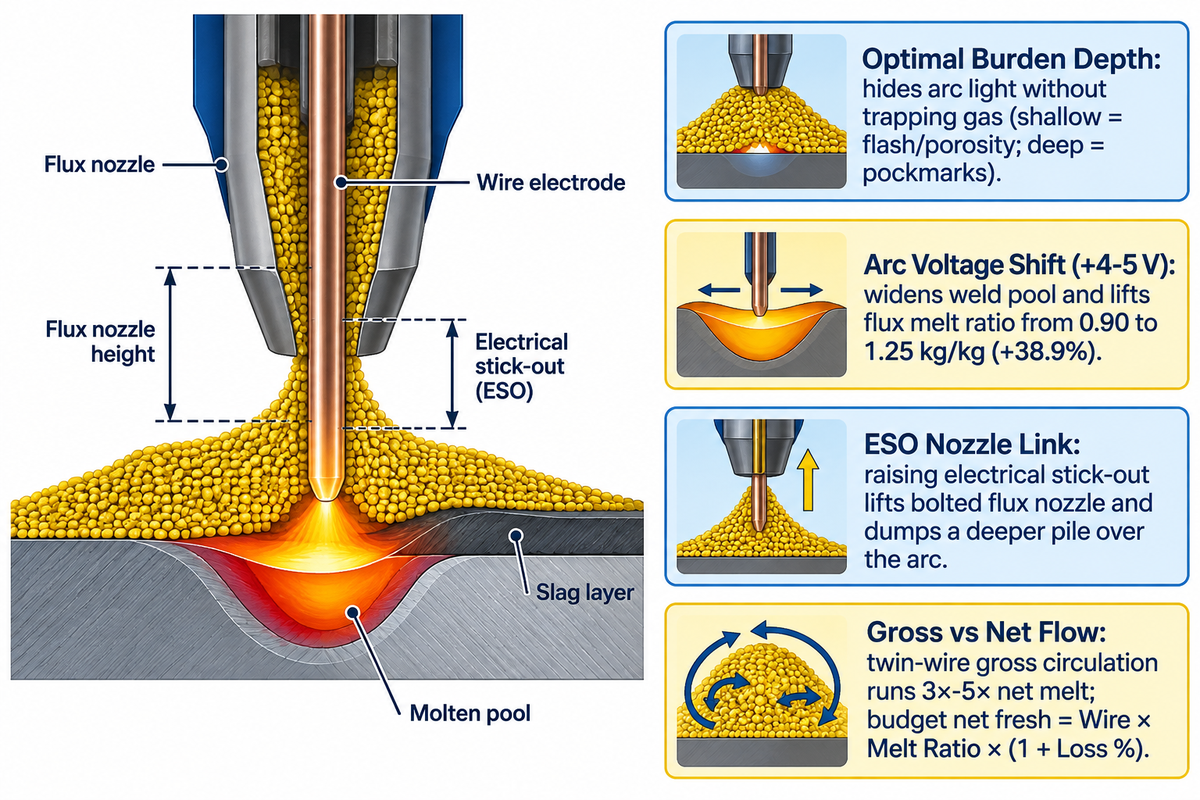
Estimate depth for the granular blanket enough to cover the arc light without obstructing gas escape, and plan net fresh flux near 0.90-1.25 kg/kg of wire laydown (gross hopper flow runs 3×-5× higher). Too shallow a blanket will cause arc flash and air pick-up. Too deep a blanket will trap gas and leave surface pock marks or ropey beads.
How Does Arc Voltage Change SAW Flux Consumption Ratio and Bead Chemistry?
Increasing arc voltage widens the weld pool and raises the flux melt ratio, from 0.90 to 1.25 kg/kg (+38.9%) in a 4-5 V sample calculation, while adding Mn and Si from active flux into the weld. According to Canadian Fabricating & Welding, increasing the voltage causes more flux to melt out and deposit onto the weld. In active or alloying fluxes, voltage drift makes multi-pass welds harder and more susceptible to cracking.
Careful control of welding parameters (electrical stick-out (ESO), voltage, current, and travel speed) will ensure bead profile and flux consumption remain stable.
Electrical stick-out also changes flux burden automatically on mechanized heads. As The Welder’s structural SAW analysis by Nino Mascalco notes, flux nozzles usually bolt straight to the torch. Extending ESO past procedure limits lifts the nozzle and dumps a deeper pile over the wire tip, choking puddle degassing.
Net-Fresh Flux Mass-Balance Worksheet (Worked Example 2)
Don’t multiply gross hopper circulation by bag price. Gross flux fed over a twin-wire head is commonly 3× to 5× higher than net melt since vacuum recovery recycles unmelted grains. Calculate purchase weight from an actual mass balance as follows:
Net Fresh Flux Needed (kg) = Wire Deposited (kg) × Melt Ratio × (1 + Fines & Spillage Loss %)
Worked Example (1,000 kg deposited carbon-steel wire; substitute your own WPS melt ratio and bag weight):
- Baseline voltage run (0.90 kg flux per kg wire + 8% dust/spillage loss): 1,000 × 0.90 × 1.08 = 972 kg net fresh flux (~43 bags of 50 lb / 22.7 kg).
- High-voltage run (+4–5 V wider bead, 1.25 kg/kg melt ratio + 8% loss): 1,000 × 1.25 × 1.08 = 1,350 kg net fresh flux (~60 bags), a 38.9% jump in flux spend on identical wire tonnage.
- Blend sanity check: under the 1:3 new-to-recycled rule (25% minimum virgin share), continuous melting pulls fresh makeup into the tank each shift; screen fines and fused slag continuously, and never sweep floor-spilled flux back into the hopper.
How Much Does Submerged Arc Welding Flux Cost? Bag vs. Bulk Pricing and Recovery Economics
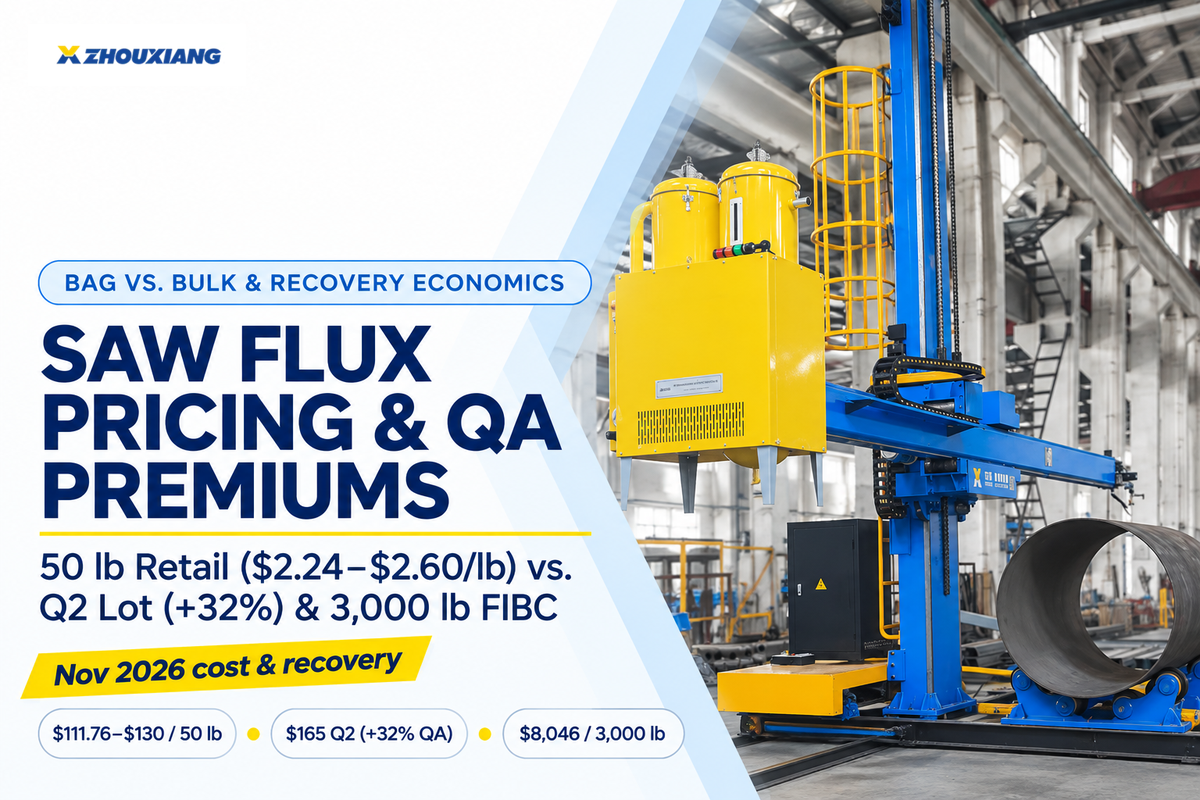
In November 2026, U.S. welding distributors listed standard 50 lb (22.7 kg) carbon-steel SAW flux bags at $111.76–$130.00 ($2.24–$2.60/lb), while Q2 lot-tested, low-hydrogen, and stainless bags ran $165.00–$414.01. Online 3,000 lb bulk bags listed at $2.68/lb, while lower factory FIBC unit pricing comes from annual supplier contracts.
The table below compiles live U.S. distributor retail prices verified in that month across standard bags, Q2 certified SKUs, specialty alloys, and distributor bulk bags.
| Product / Flux Option | Category / Package | Listed Price (Nov 2026) | Unit Rate ($/lb) | Distributor & Notes |
|---|---|---|---|---|
| Lincolnweld 960 (ED022412) | Neutral carbon steel; 50 lb bag | $111.76 – $115.00 | $2.24 – $2.30 | WeldingMart ($111.76) / Harris Welding Supplies ($115.00) |
| Lincolnweld 860 Standard (ED019589) | 800-series neutral; 50 lb bag | $123.68 – $125.00 | $2.47 – $2.50 | WeldingMart ($123.68) / Harris Welding Supplies ($125.00); Type 3.1 lot cert available |
| Lincolnweld 780 (ED019586) | Active carbon steel; 50 lb bag | $128.15 – $130.00 | $2.56 – $2.60 | WeldingMart ($128.15) / Harris Welding Supplies ($130.00) |
| Lincolnweld 860 Q2 Lot (ED030840) | Neutral + Q2 actual mechanical test; 50 lb bag | $165.00 – $165.01 | $3.30 | Harris Welding Supplies ($165.00) / WeldingMart ($165.01); 32% QA-testing premium over ED019589 |
| Lincolnweld 812-SRC (ED034171) | Low-hydrogen moisture-resistant; 50 lb plastic bag | $240.01 | $4.80 | WeldingMart single-bag retail list |
| Lincolnweld A-96-S (ED031860) | Stainless steel SAW flux; 60 lb plastic bag | $414.01 | $6.90 | WeldingMart single-bag retail list |
| Lincolnweld 801 Bulk (EDS30786) | Distributor 3,000 lb bulk FIBC bag | $8,046.01 | $2.68 | WeldingMart online list; direct mill-contract FIBC pricing requires supplier RFQ |
Two clear pricing patterns emerge from these retail listings. First, Q2 lot-tested certification adds 32% per bag ($165.00 vs. $125.00 for identical Lincolnweld 860 chemistry). Specify Q2 testing only when code contracts demand actual lot mechanical reports. Check your contract’s AWS carbon-steel SAW flux specification before paying for lot-tested bags. Second, an online distributor 3,000 lb FIBC (Lincolnweld 801 at $2.68/lb) can cost more per pound than a different grade’s 50 lb bag (Lincolnweld 860 at $2.47/lb). True bulk discounts come from annual pallet or container contracts negotiated directly with the consumable supplier.
Common Mistakes in SAW Flux Storage, Redrying, and Vacuum Recovery
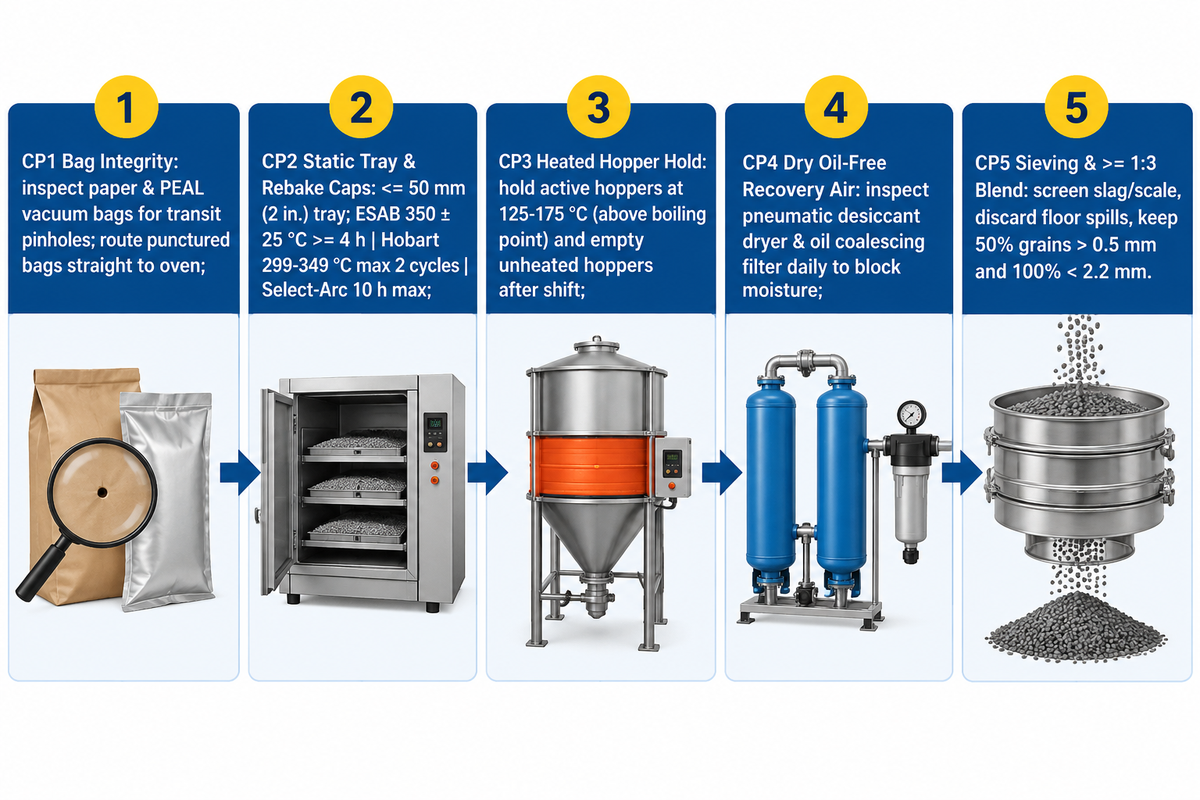
A majority of the SAW defects on the shop floor impacting weld performance result from just five mishandlings. Shops tend to impose a single oven schedule onto diverse chemistries or load flux beyond the capacity of the shallow trays in static ovens. These are aggravated by leaving open bags unheated overnight, introducing moist shop air to the vacuum reclaim units and reclaiming powdery dust.
The maximum OEM storage and rebaking limits differ widely by brand. Assign the appropriate OEM manufacturer’s schedule to each hopper:
| Handling Parameter | ESAB (Exaton Guide) | Hobart Brothers | Select-Arc (ARCFLUX) |
|---|---|---|---|
| Unopened storage climate | 20 ± 10 °C; RH ≤ 70% | Clean, dry indoor storage | 10–30 °C (50–85 °F); RH ≤ 70% |
| Unopened shelf life | Up to 5 years (sealed 25 kg drums) | Up to 3 years (heat-sealed bags) | 1 year agglomerated; 3 years fused |
| Opened / hopper holding temp | 150 ± 25 °C (after 8 h shift) | 124–174 °C (255–345 °F) | 150 ± 25 °C (300 ± 25 °F) |
| Rebaking temperature & time | 350 ± 25 °C for ≥ 4 hours | 299–349 °C (570–660 °F) for ≥ 2 hours | FB/AB: 300–350 °C; AR: 150–200 °C; CS: 150–250 °C (2–10 h) |
| Maximum tray depth / rebake cap | ≤ 50 mm tray depth | Max 2 reconditioning cycles | ≤ 50 mm (2 in.) tray; 10 h cumulative max |
| Virgin-to-recycled blend & grain limit | ≥ 1 part new : 3 parts recycled; sieve mill scale/dross | Blend fresh flux continuously; screen fines | ≥ 1:3 blend; 50% grains > 0.5 mm & 100% < 2.2 mm; zero floor-spilled reuse |
5-Checkpoint Flux Recovery & Rebake Ledger
- Checkpoint 1, Bag integrity before loading: inspect paper and PE-coated aluminum (PEAL) vacuum bags for transit pinholes, and route any punctured bag straight to the baking oven.
- Checkpoint 2 – Tray depth and oven cycle log: hold static tray depth at or below the 2 in. OEM tray limit so core grains reach bake temperature, and log cycles against the brand cap (2 cycles for Hobart; 10 cumulative hours for Select-Arc).
- Checkpoint 3 – Heated hopper hold: ensure active hoppers are held above the boiling point of water (125-175 °C per OEM) and at the end of the shift empty flux from unheated hoppers into holding ovens.
- Checkpoint 4 – Dry, oil-free recovery air: examine the desiccant dryer and oil coalescing filter on the pneumatic unit every day to keep wet compressed air from reaching dry flux grains.
- Checkpoint 5, Sieving, magnetic separation, and grain check: screen fused slag and mill scale continuously, discard floor-spilled flux, and keep 50% of recovered granules above 0.5 mm rather than dusty flux powder.
Unfused Flux Recovery vs. Crushed Slag and Shop-Floor Hydrogen Control
Strictly avoid combining unfused granular flux recycling with slag recrushing. As The Welder points out, flux recycling recovers only the unmelted granular overburden atop the slag crust. Crushing solidified fused slag upsets chemistry and removes deoxidizers.
Structural and vessel codes forbid recrushed slag unless that particular crushed lot is tested and qualified as a new flux.
Dry flux handling is also closely related to steel preheat and interpass control. Humidified standard flux elevated diffusible hydrogen in the Lincoln Electric offshore SAW study to near 15 mL/100 g (triple the 5 mL/100 g maximum most inspectors tolerate). Moisture-resistant low-hydrogen grades stayed under 3 mL/100 g.
Even worse, high diffusible hydrogen was found in greatest concentration per 100 g of weld metal in the first root pass. A 250 °F (121 °C) soak on a single-pass test piece needed over one hour just to reduce its initial hydrogen by half. Keeping flux dry initially is far less expensive than the multi-hour dehydrogenation soaks.
Troubleshooting SAW Flux Defects: Porosity, Pockmarking, Cracking, and Slag Entrapment
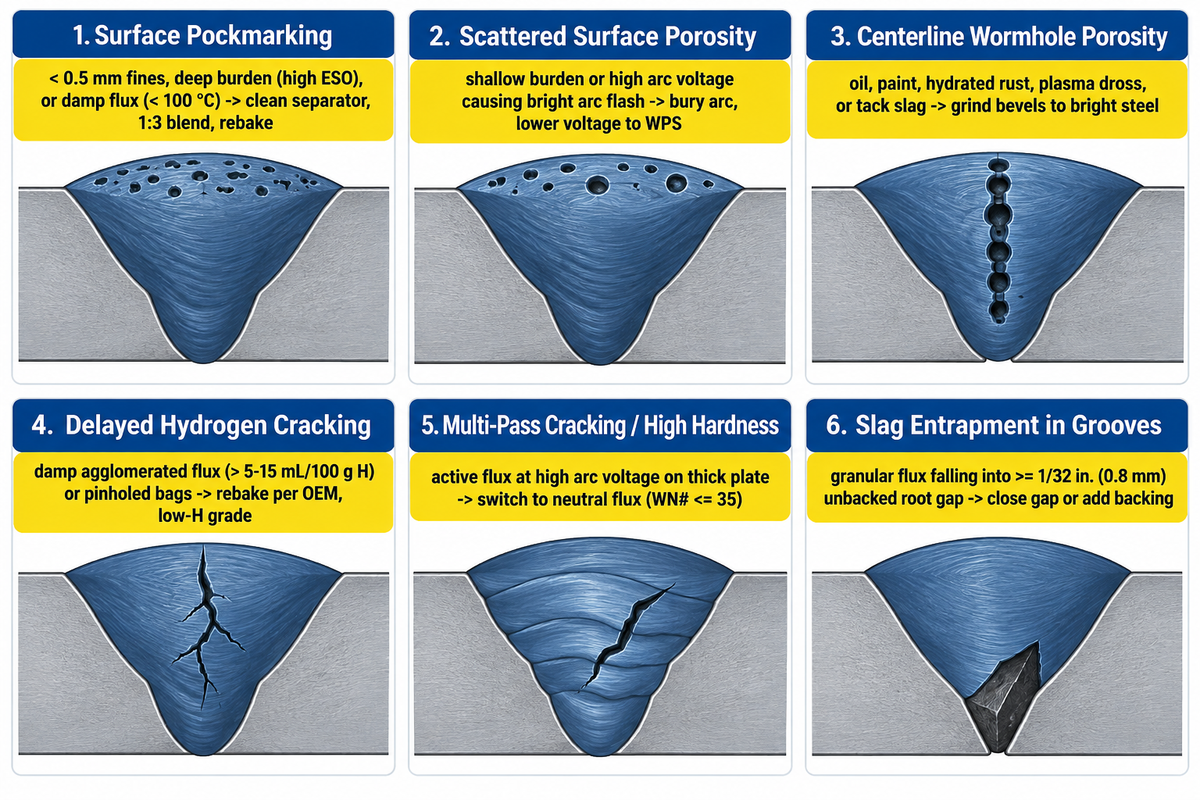
Trace surface pockmarking to fines below 0.5 mm or deep burden, hydrogen cracking to damp flux above 5 mL/100 g, and multi-pass cracking to high voltage on active flux prior to changing the wire. A confirmation you loaded the correct flux first will help isolate whether it’s a moisture, fines, burden, or chemistry problem with no need for guessing.
| Weld Defect Symptom | Primary Flux-Side Root Cause | Shop Verification Check | Corrective Action |
|---|---|---|---|
| Surface pockmarking / gas flats | Excess fines blocking gas escape, deep burden from high ESO, or damp flux (< 100 °C) | Check grain feel (< 0.5 mm fines), measure ESO, check hopper temp and air dryer | Clean recovery separator, restore 1:3 virgin blend, reset ESO, rebake flux |
| Scattered surface porosity with arc flash | Shallow flux burden or excessive arc voltage letting air enter the weld pool | Watch for bright flashes through blanket; log actual arc voltage at head | Increase flux depth to bury arc fully; lower voltage to WPS window |
| Centerline wormhole porosity | Oil, paint, hydrated rust, plasma-cut dross, or tack-weld slag inside joint | Inspect joint bevels and tack welds prior to laying granular flux | Grind bevels to bright steel, strip plasma dross, remove stick tack slag |
| Delayed transverse / root hydrogen cracking | Damp agglomerated flux (> 5–15 mL/100 g H) or pinholed bags | Audit bag seals, oven bake logs, and compressed-air condensate traps | Switch to low-H moisture-resistant flux, rebake per OEM, verify preheat |
| Multi-pass weld cracking / high hardness | Active flux used on thick multi-pass plate with high arc voltage (Mn/Si pickup) | Verify flux WN# and pass count against manufacturer datasheet | Replace active flux with qualified neutral (WN# ≤ 35) flux and requalify WPS |
| Slag entrapment & sticky slag in grooves | Flux falling into ≥ 1/32 in. (0.8 mm) unbacked butt gap, or wrong slag chemistry | Measure root gap fit-up and check bead convexity / sidewall fusion | Add backing strip/weld for ≥ 0.8 mm gaps; use narrow-groove AB flux; check weld toe undercut causes and travel-speed limits |
Why Does Reclaimed SAW Flux Cause Surface Pockmarking and Wormtracks?
Reclaimed SAW flux causes surface pockmarking when repeated vacuum cycles crush fragile agglomerated grains into fine dust that traps escaping gas. TWI Global’s SAW porosity troubleshooting guide links surface pocking to three overlapping causes: moisture in the flux or air line, insufficient deoxidants, and excessive fines.
Published troubleshooting in The Welder on structural A36 and A572 I-beams clearly shows how quickly these elements come together. Even an unopened paper bag may take on moisture via tiny transit pinholes. Slowing down the travel speed a little can give the gas the time it needs to boil out as the technicians clean the recovery separator.
Ensure those working the hot ovens, the dusty separators and slag removal are properly equipped with PPE as per OSHA 3151 Personal Protective Equipment guidance.
What to Ask Suppliers Before Ordering SAW Flux, and What Changed in AWS A5.17/A5.17M:2025
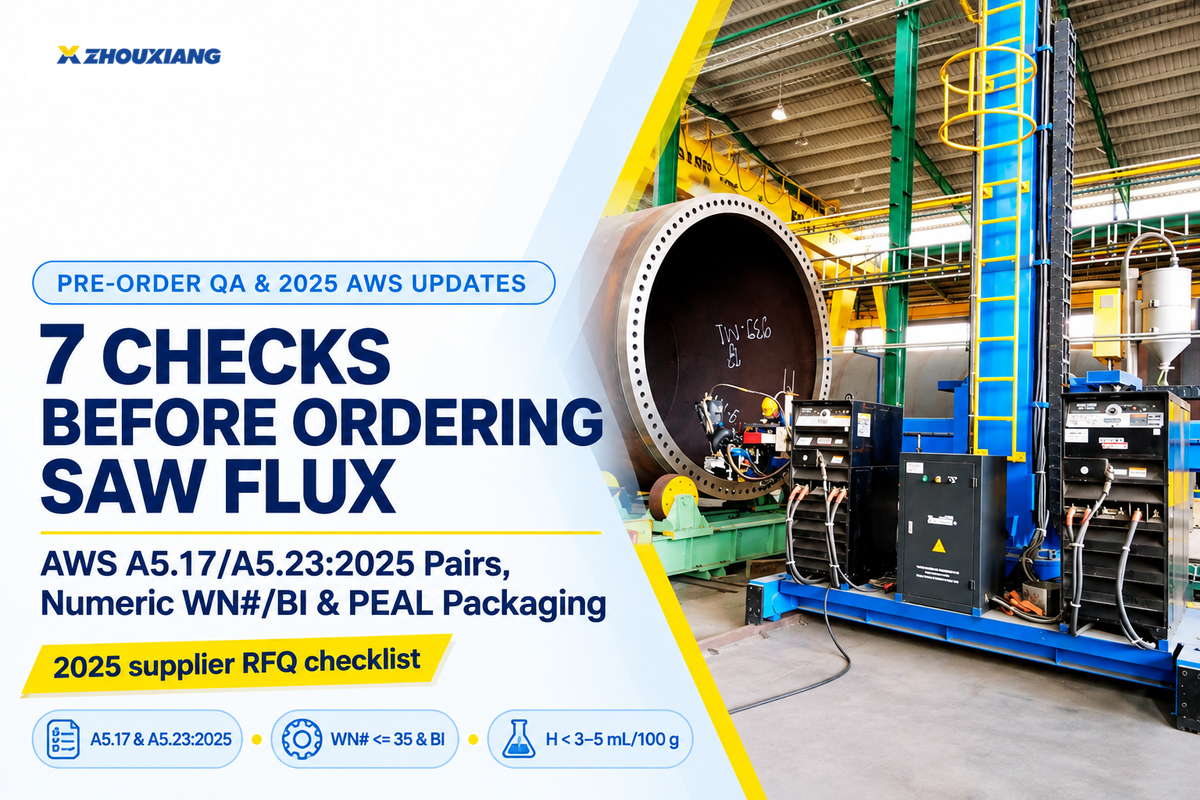
Before ordering flux, require matching wire-flux certificates, numeric WN# and BI values, and rebake caps per the active 2025 AWS SAW specifications (A5.17/A5.17M:2025 and A5.23/A5.23M:2025). Both active editions classify flux strictly as paired electrodes within separate U.S. and SI tables. Alongside those updates, manufacturers increasingly ship low-hydrogen fluxes in vacuum-sealed PE-coated aluminum (PEAL) bags and lined FIBC totes to hold diffusible hydrogen below 3–5 mL/100 g straight from the bag.
Before approving a vendor or changing a grade, it’s recommended to include seven checks in your purchase inquiry:
7-Point SAW Flux Supplier RFQ & Pre-Order Verification Checklist
- Active standard and exact wire pairing: confirm qualification under AWS A5.17/A5.17M:2025, AWS A5.23/A5.23M:2025, or ISO 14174 with your exact wire grade and diameter.
- Numeric WN# and Boniszewski BI: request both the Wall Neutrality Number (≤ 35 for neutral) and numeric BI on the datasheet, not verbal labels alone.
- PWHT and two-run (T) tests: verify the equivalent P-condition mechanical properties certificate for vessels that have undergone stress relief, or the AWS T-suffix certificate for two-run seams.
- Lot-specific certification tier: Specify if regular Type 3.1 certificates will do, or if your client requires actual Q2 mechanical tests of the lot.
- Moisture-barrier packaging and shelf life: verify paper bag, PEAL vacuum bag, steel drum, or lined FIBC format in addition to unopened shelf lifespan from delivery.
- Obtain data on written limits for rebaking and recovery including official bake temperatures and hold times, maximum static tray depths, cycle/hour limits and minimum virgin blend ratios.
- Get the cost per tonne for an annual volume of FIBCs or pallets delivered to site plus lead times and replacement terms for punctured bags.
Planning an Automated H-Beam or Wind-Tower SAW Production Line?
Wuxi Zhouxiang Complete Set of Welding Equipment Co., Ltd. builds integrated H-beam SAW welding lines (PHJ0815 / PHJ0820) and wind-tower SAW stations. Let us know your beam dimensions, plate thicknesses, and desired speed so that we can go over our line options with you.
Frequently Asked Questions About Flux for Submerged Arc Welding
What is the function of flux in submerged arc welding?
In submerged arc welding, granular flux buries the electric arc so that it isn’t exposed to the atmosphere, stabilizes the arc, and supplies deoxidizers or alloying elements where formulated. The molten slag layer both contours the weld bead and slows its cooling. Because it covers the arc, it suppresses fumes and spatter, and gives higher deposition rates than open-arc processes.
Which flux is used in submerged arc welding for structural carbon steel?
For single-pass structural fillets over light mill scale, choose an active agglomerated flux, and for multi-pass thick plate choose a neutral aluminate-basic / fluoride-basic flux (WN# 35 or lower). The active grade has higher levels of manganese and silicon deoxidizers enabling a faster fillet travel speed. The neutral basic grades keep the weld chemistry stable over unlimited passes, meeting sub-zero Charpy impact requirements when used with EM12K or low-alloy wire.
Can used SAW flux be recovered and recycled, or should it be discarded after welding?
Yes, unfused granular flux above the slag crust can be vacuum-recovered at a minimum 1:3 new-to-recycled ratio, whereas solidified fused slag and floor-spilled flux must be discarded. Your recovery unit must run dry, oil-free compressed air and screen out slag chips, mill scale, and dusty fines. Select-Arc also specifies keeping 50% of recovered grains above 0.5 mm.
Do I need to buy wire and flux separately for SAW, and how do they work together?
Yes, submerged arc welding makes use of separate bare wire electrode drums or spools as well as granular flux bags. Under the AWS A5.17 and A5.23 standards, these qualify only as matched pairs because the two components combine to control final weld chemistry and toughness.
Can flux for submerged arc welding be used on aluminum?
Typical steel SAW fluxes aren’t for aluminum alloys. Commercial submerged arc welding focuses on carbon steel, low-alloy steel, stainless steel, and nickel overlays. Aluminum fabrication relies on gas metal arc welding (GMAW) or gas tungsten arc welding (GTAW) using inert argon shielding.
For typical gravity-fed granular flux, submerged arc welding orientations are restricted primarily to flat (1G/1F) and horizontal (2F/2G) unless retaining shoes support the blanket. Because the buried arc occludes the molten weld pool from view, accurate seam tracking and tight joint fit are essential. Unbacked butt gaps of 0.8 mm or wider let granular flux fall ahead of the arc and cause slag entrapment.
In addition, a moist shop environment causes agglomerated basic fluxes to absorb moisture rapidly and crumble into powder over multiple vacuum cycles, necessitating heated hoppers, oven rebake logs, oil-free recovery air, and thorough slag removal between passes. Lastly, the elevated heat input results in deep dilution that renders thin sheet metal unsuitable at conventional SAW parameters.
How many times can submerged arc welding flux be rebaked?
Hobart Brothers limits rebaking to two cycles (299-349 °C for at least 2 hours), while Select-Arc permits multiple cycles with a maximum total of 10 hours. Always adhere to the lower OEM rebaking limit as printed on the datasheet for the batch.
References & Sources
- AWS A5.17/A5.17M:2025, Specification for Carbon Steel Electrodes and Fluxes for Submerged Arc Welding American Welding Society (AWS)
- Consumables Corner: The differentiating factors in SAW flux The Welder (Fabricators and Manufacturers Association)
- Submerged arc welding consumables – Part 1 (Job Knowledge 87) The Welding Institute (TWI)
- US4221611A, Non-fused flux composition for submerged-arc welding United States Patent and Trademark Office (Google Patents)
- Submerged arc welding consumables selection Canadian Fabricating & Welding
- Consumables Corner: Identifying pockmarking causes in structural SAW The Welder (Fabricators and Manufacturers Association)
- What are the common causes of porosity in SA (submerged arc) welds? The Welding Institute (TWI)
- Personal Protective Equipment (OSHA 3151) Occupational Safety and Health Administration (U.S. Department of Labor)